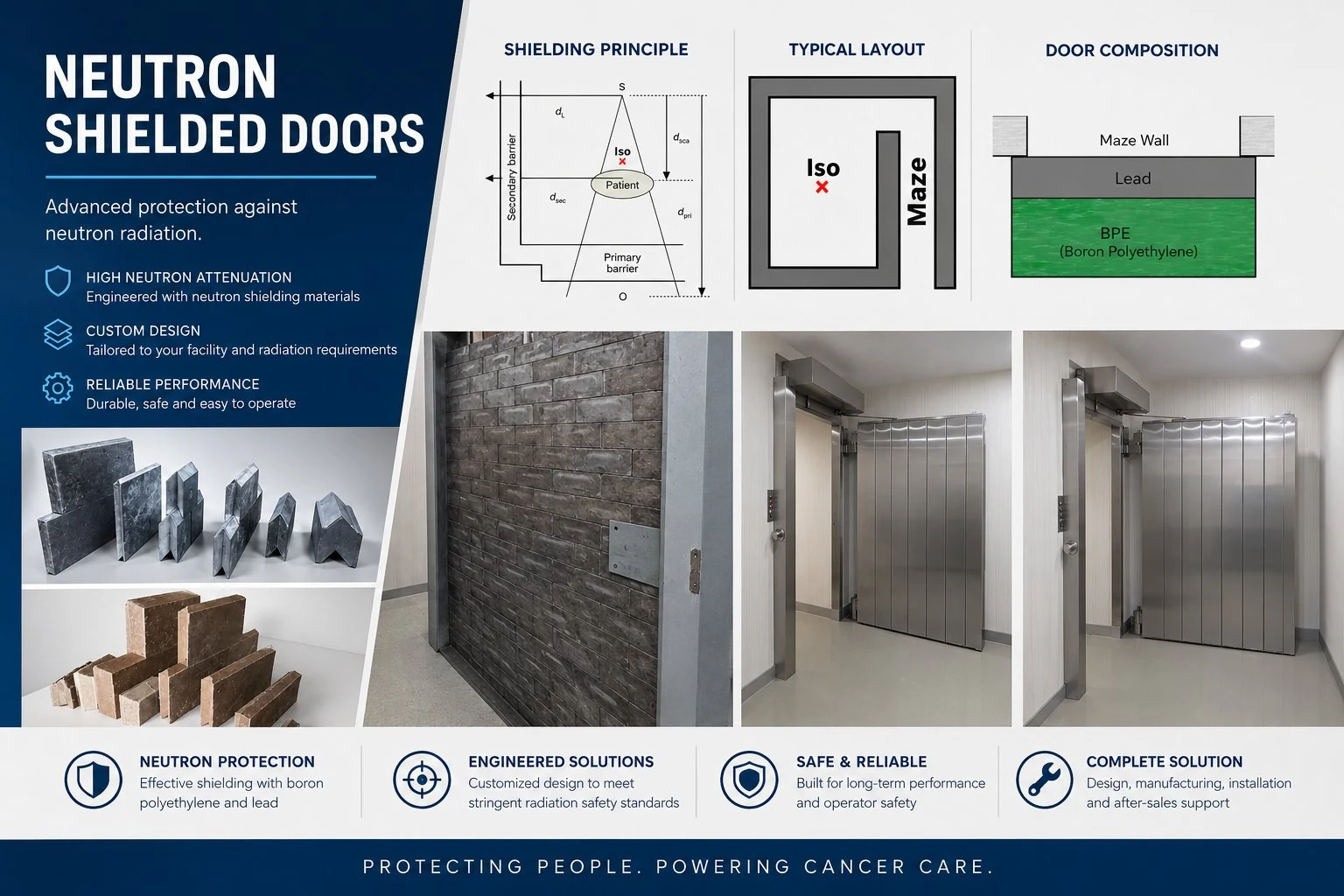
The Most Demanding Door in the Building
A medical cyclotron accelerating protons to 9–24 MeV for PET radiopharmaceutical production creates, per hour of operation, a radiation environment far more intense than any radiotherapy vault. When the proton beam strikes the target to produce fluorine-18 or other PET nuclides, nuclear reactions release neutrons in enormous quantities — orders of magnitude beyond the photoneutron field of a high-energy LINAC — together with prompt gamma radiation. These neutrons scatter throughout the vault, activate the air and surrounding components, and press on every weakness in the shielding envelope. The door is the largest deliberate weakness in that envelope, and it must be engineered accordingly.
This is why cyclotron doors are a discipline of their own: greater shielding thickness, greater mass, purpose-designed drive systems and an interlock philosophy that accounts not only for beam-on radiation but for the residual activation field that remains after the beam stops.
Two Radiation Problems, One Door
The shielding build-up addresses two distinct fields in sequence. The neutron field is handled the way physics dictates: hydrogen-rich borated polyethylene or borated paraffin composite thermalizes fast neutrons through elastic scattering, and the boron-10 distributed through the same layer captures them, emitting a comparatively soft 478 keV gamma. The gamma field — prompt gammas from the target region, capture gammas from the shielding itself and scattered photons streaming along the entrance path — is then attenuated by a lead layer sized in the same calculation. A welded steel chassis binds the package into a single structural unit and transfers its multi-tonne mass into the drive system.
Layer thicknesses are never generic. They emerge from the vault’s specific parameters: the cyclotron model and whether it is self-shielded, the target nuclides and beam currents, projected weekly irradiation hours, the entrance geometry and the occupancy of the spaces beyond. We carry this calculation per NCRP and IAEA methodology and dimension the door — and only then its mechanics — from the result.
Plug Doors and Heavy Sliding Doors
Cyclotron vault entrances are typically built without a full maze, or with only a short entry recess, which puts the door directly in the radiation path. Two mechanical concepts dominate, and we manufacture both:
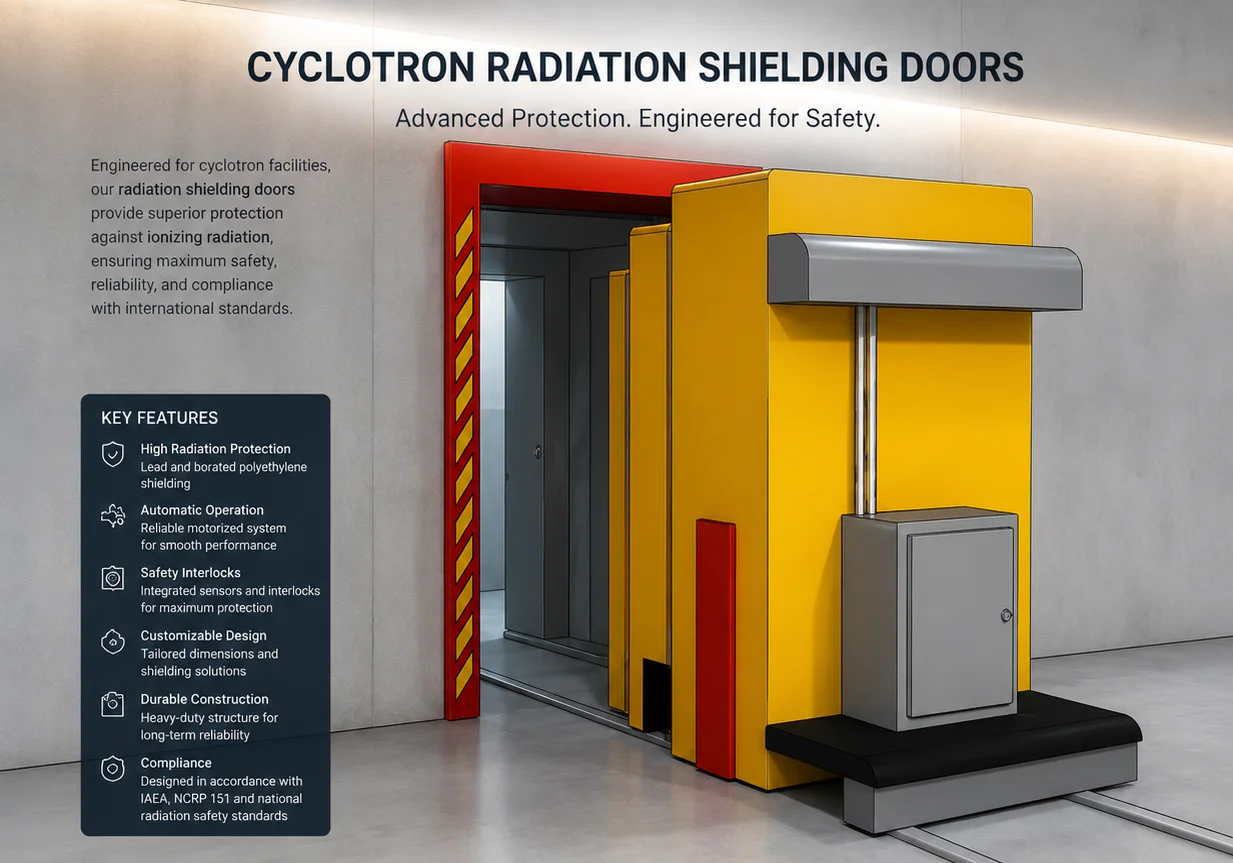
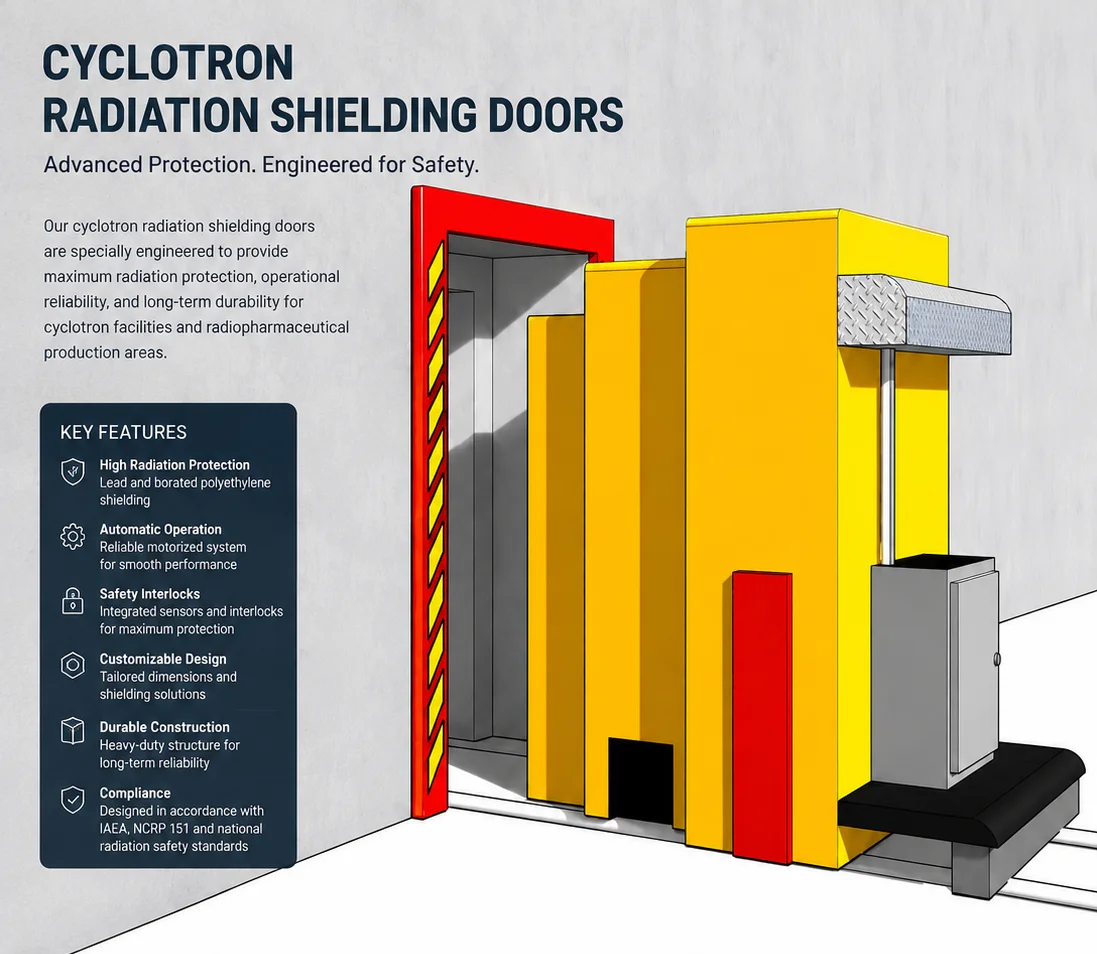
- Shielded plug doors — the door body is built as a stepped plug whose profile nests into a matching recess in the concrete wall. The stepped, overlapping geometry eliminates any straight-line gap between door and wall, which is the decisive advantage in a high neutron field: radiation cannot stream through a joint that never runs straight. The plug travels on a floor-mounted heavy rail system, driven clear of the opening for access.
- Heavy sliding doors — a multi-layer flat leaf on load-rated floor rails, with generously overlapping shielded reveals on all four edges. Preferred where the vault layout provides an entry recess that already breaks the line of sight, or where lateral parking space favors a flat leaf.
In both concepts the wall interface matters as much as the door. We supply the embedded steel frame that is cast into the concrete during vault construction — it defines the opening profile to millimetre accuracy, maintains a constant engineered perimeter gap, and carries the pre-arranged conduits for push buttons, safety devices and interlock wiring. Coordinating this frame with the construction team before the concrete pour is part of our standard project scope, because retrofitting precision into cured concrete is expensive and never as good.
Drive and Safety Engineering for Multi-Tonne Leaves
| System | MSA Projecta Approach |
|---|---|
| Drive | Industrial gear-motor with inverter control; PLC-managed soft acceleration and deceleration ramps so a multi-tonne leaf starts and stops without shock loads |
| Rails & carriages | Floor-mounted heavy rail system rated for the full shielding mass with engineering margin; machined carriages for smooth, repeatable travel |
| Manual emergency operation | Mechanical hand-crank facility acting on the drive train; engaging it cuts motor power automatically so powered and manual operation can never conflict |
| Interlocks | Door position integrated into the cyclotron’s safety chain — beam cannot run with the door open; opening is inhibited during irradiation and release can be delay-conditioned for post-irradiation dose decay |
| Personnel safety | Anti-crush presence detection, audible and visual movement warnings, emergency stop devices on both faces, battery-backed operation and last-person-out search procedure support |
| Verification | Commissioning with neutron and gamma surveys around the closed door before radiopharmaceutical production begins; documented for the regulator |
Activation — the Radiation That Stays After the Beam Stops
Unlike a LINAC vault, a cyclotron vault is not immediately at background level when the machine stops. Activated air, components and dust create a residual field that decays over minutes, and vault ventilation must run its exchange cycle before entry. A properly engineered cyclotron door participates in this workflow: its interlock logic can enforce a configurable post-irradiation delay, its status signals feed the facility’s access control and radiation monitoring systems, and its sealing performance supports the vault’s negative-pressure ventilation regime. We coordinate these interfaces with the cyclotron vendor and the facility’s radiation safety officer during design, so the door arrives speaking the same language as the rest of the installation.
Self-Shielded Cyclotrons Still Need Engineered Doors
Many modern PET cyclotrons ship with integral self-shielding, which reduces — but does not eliminate — the vault shielding requirement. Escape radiation during irradiation, activation dose after it, target maintenance scenarios with shielding open, and the regulator’s conservative assumptions all keep the vault door a calculated shielding element. For self-shielded installations the door specification is lighter than for an unshielded machine, and we size it from the vendor’s radiation output data rather than applying worst-case defaults — which is how a project avoids paying for steel and boron it does not need.
One Partner from Concrete to Commissioning
Our cyclotron door scope runs the full arc: shielding calculation, embedded frame supply during construction, door manufacturing with in-house material quality control, installation, interlock integration with the cyclotron and building systems, and final radiation surveys with acceptance documentation. Combined with our treatment room design and project management services, a hospital adding PET production capability gets its most demanding shielded opening from a partner that has engineered the rest of the radiotherapy chain for twenty years.
The PET Facility as a Shielding System
The vault door is the heaviest single shielding element in a PET production facility, but it never works alone. Produced activity leaves the vault through shielded transfer routes toward the hot laboratory; the radiochemistry area carries its own structural shielding; and every wall penetration for ventilation, dispensing lines and cabling is a potential leak that must be engineered as carefully as the door edge. Because MSA Projecta supplies shielding calculations, doors and certified materials from one hand, we routinely carry this whole shielding chain within a single scope — which spares the project the classic failure mode of three suppliers each assuming the gap belongs to someone else.
Materials and Quality Control
Cyclotron doors consume shielding materials in quantities that make quality non-negotiable. Our lead conforms to ASTM B-29 with defect-free surfaces and tightly controlled thickness; our borated polyethylene and paraffin composites carry certified minimum 5% boric oxide content per IAEA guidance, because a boron shortfall silently converts soft 478 keV capture gammas into hard 2.2 MeV hydrogen-capture gammas that the lead layer was never sized for. Every plate and panel that enters a door is processed and verified in-house, and material certificates travel with the project documentation — the regulator sees traceability, not assurances.
A Realistic Project Timeline
A cyclotron door project healthy from the start follows a predictable arc: shielding calculation and door concept during vault design; embedded frame delivered to site ahead of the concrete pour; manufacturing running in parallel with construction; installation once the vault is structurally complete but before radiochemistry fit-out crowds the access route; and commissioning surveys aligned with the cyclotron vendor’s own acceptance program. The single most common schedule failure we see in rescue engagements is a door procured after the concrete exists — recoverable, but always at a premium in time, money and compromise. Involve the door engineering when the architect still has an eraser.
Service Life, Retrofits and Upgrades
A cyclotron door outlives several generations of the machine behind it, and its mechanics deserve the same lifecycle thinking as the facility itself. We retrofit modern PLC drives and inverter controls onto aging doors, renew rails, carriages and seals worn by two decades of daily cycles, upgrade safety chains to current expectations, and re-survey after every intervention so the paperwork keeps pace with the hardware. If your facility operates a door whose manufacturer has vanished or whose documentation never existed, a condition assessment is the sensible first step — and frequently the affordable alternative to replacement.