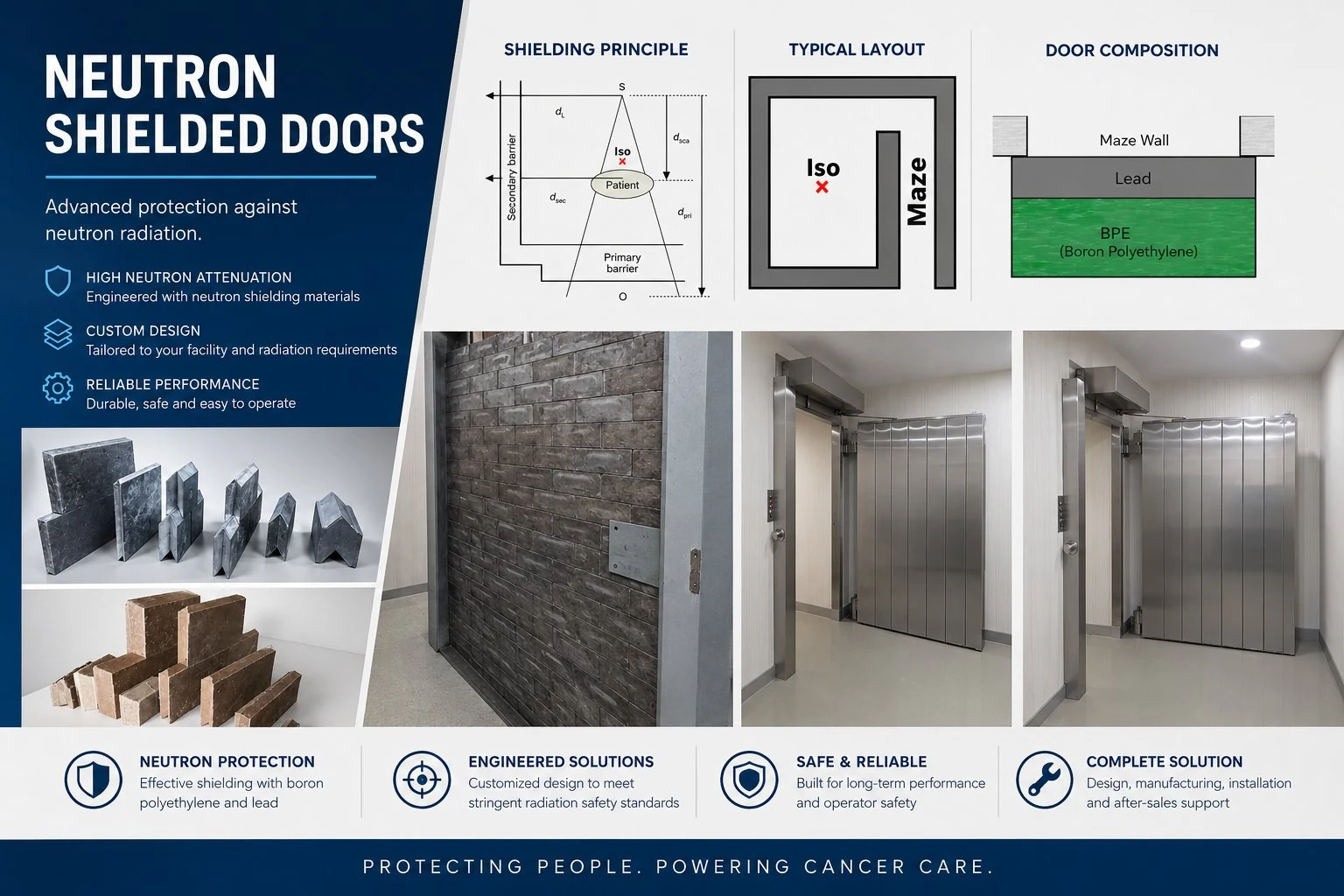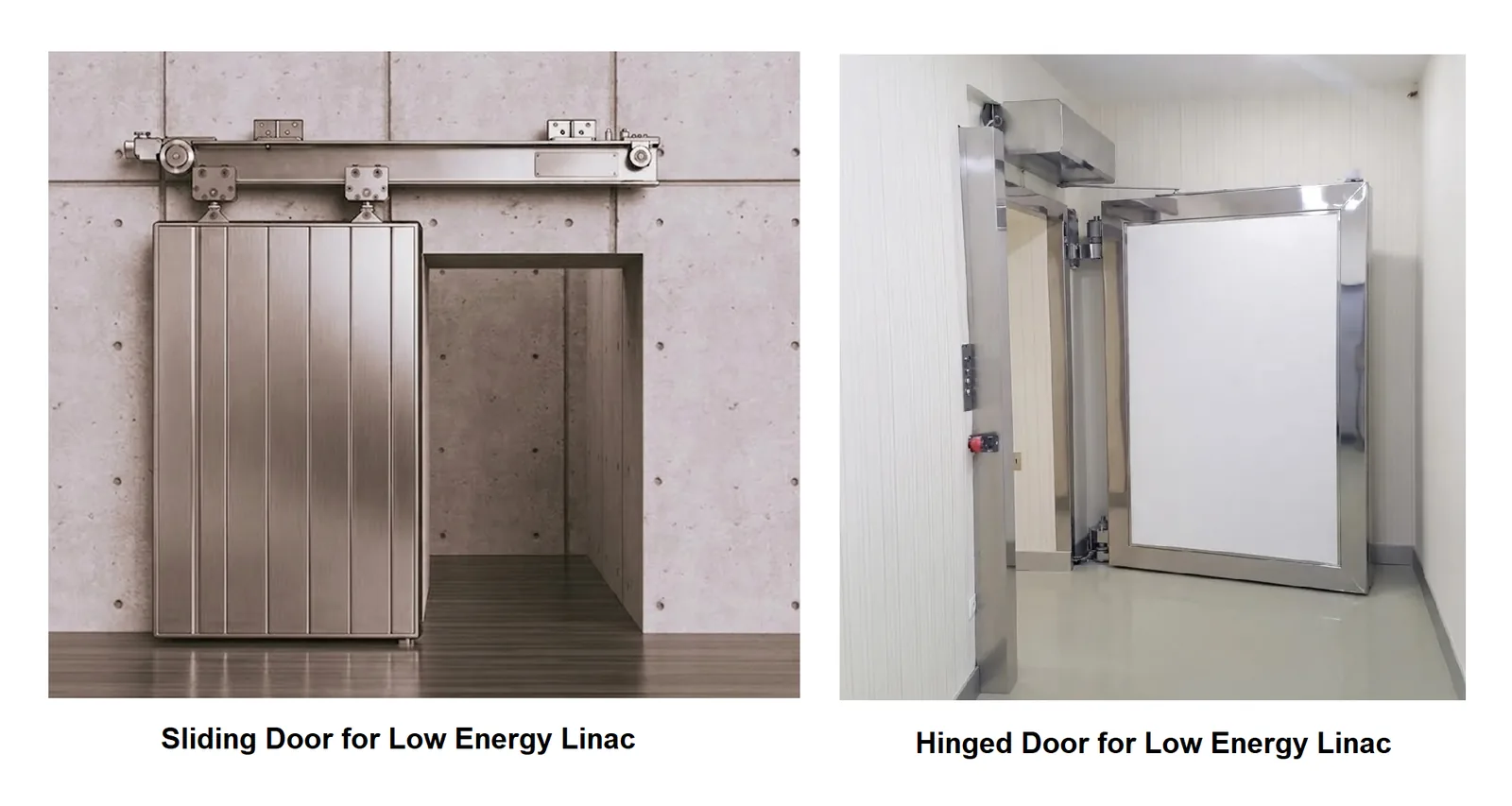
When Photon-Only Shielding Is the Right Choice
Linear accelerators operating at 6 MV — and in most configurations up to 10 MV — stay below the practical threshold where photonuclear reactions in the machine head begin producing a significant neutron field. For these vaults, the door at the maze entrance has one job: attenuating scattered photons and head-leakage radiation to the design dose limit behind the door. That job is done with high-density material, and it is done best with lead.
Because no hydrogenous neutron-moderating layer is required, low energy LINAC doors are thinner, lighter and more economical than their high-energy counterparts — which opens up design freedom: hinged single-leaf doors, compact sliding systems, or manual operation where clinical workflow allows it.
Door Construction
Every MSA Projecta low energy door is built around a continuous virgin-lead core (ASTM B-29, maximum 3% thickness variation) fully encapsulated in a welded steel chassis. The lead thickness is never a catalogue value: it is calculated for your specific project from the bunker drawings, maze geometry, machine workload, use factors and the occupancy of the area behind the door, following NCRP Report No. 151 methodology.
| Parameter | Typical Configuration |
|---|---|
| Energy range | 6 MV single energy · 6/10 MV dual energy |
| Shielding core | Continuous lead sheet/brick core, steel encapsulation |
| Door types | Hinged (single/double leaf) or sliding |
| Operation | Manual, electro-mechanical or fully automatic PLC-controlled |
| Safety systems | Interlock circuit, presence detection, emergency release, battery backup |
| Design basis | NCRP 151 · IAEA Safety Reports Series No. 47 · local regulatory limits |
Maze Bunkers vs. Direct-Shielded Doors
In a properly designed maze bunker, the door receives only multiply-scattered radiation, so the required lead thickness stays modest and the door remains light enough for smooth manual or hinged operation. In space-constrained facilities without a maze, the door itself becomes part of the secondary barrier — a direct-shielded door — and its lead content grows substantially, which usually dictates a motorized sliding design. We engineer both configurations and advise at the project design stage which layout serves your floor plan, patient throughput and budget best.
From Drawings to a Commissioned Door
- Data collection — bunker drawings, machine model and energies, workload and occupancy data
- Shielding calculation — NCRP 151 barrier and maze-scatter analysis, door specification report
- Manufacturing — in-house lead processing and quality control, welded steel construction
- Installation — site survey, mounting, alignment, interlock integration with the LINAC
- Verification — radiation leakage survey around the closed door before clinical use