Where X-Ray Doors Are Required
Every room that houses X-ray generating equipment needs its openings engineered as carefully as its walls. Radiography and fluoroscopy rooms, CT suites, interventional cardiology and angiography labs, mobile C-arm operating theatres, dental volumetric imaging rooms and veterinary X-ray facilities all operate in the kilovoltage range — typically 50 to 150 kVp — where the radiation reaching the door is scatter from the patient and equipment rather than a direct beam. The physics is gentler than in a radiotherapy vault, but the regulatory obligation is identical: the dose behind the door must be brought below the design limit for the occupancy of the adjacent space, and the door must prove it.
MSA Projecta manufactures lead lined X-ray doors as part of the same engineering discipline we apply to LINAC vault doors: the lining is specified from a shielding calculation, the shielding envelope is continuous across leaf, frame and wall junction, and the installed door is verified before handover.
Shielding Specification — Millimetres That Must Be Right
X-ray door linings are specified in millimetres of lead equivalence, and the correct value is a function of four things: the equipment type and its maximum operating potential, the weekly workload of the room, the distance and direction of the door relative to the scatter source, and the occupancy of the space behind the door. A quiet single-radiography room and a high-throughput interventional lab can differ several-fold in their requirement. We take these parameters from your project shielding report — or produce the calculation ourselves through our treatment room design service — and specify the lining accordingly, commonly in the range of one to three millimetres of lead equivalence for diagnostic rooms, always confirmed per project rather than assumed.
Construction and Options
Each door is built as a complete shielded opening system, not a leaf alone:
- Continuous lead lining bonded within the leaf, with lead-wrapped frame profiles so no unshielded gap exists between leaf, frame and the wall’s own lining
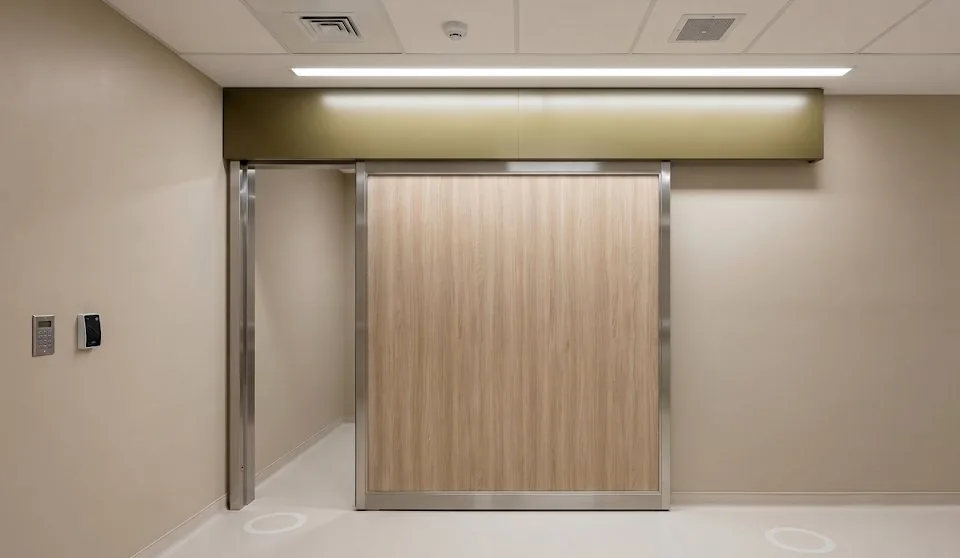
- Hinged single or double leaf as standard; concealed overhead sliding or automatic sliding operation for cath-labs and accessibility-critical routes
- Lead glass observation windows with equivalence matched to the door lining, where visual contact with the patient benefits the workflow
- Clinical finishes — laminate, wood veneer, hygienic HPL surfaces and custom colors that let the door disappear into the department interior
- X-ray-in-use warning light integration, access control preparation and heavy-duty hardware rated for high daily cycle counts
From Drawing to Verified Door
The process mirrors our radiotherapy work: we collect the room drawings and equipment data, fix the lead specification against the shielding report, manufacture with in-house quality control on every lead component, install with aligned frames and calibrated closing hardware, and finish with a scatter-radiation leakage check around the closed door. The result is documentation your radiation safety officer can file, not just a door that looks the part.
Because MSA Projecta supplies shielded doors across the entire imaging and therapy chain — X-ray, CT simulator, brachytherapy and LINAC vaults — hospitals building or renovating a whole department can specify every shielded opening through one engineering partner, with one interlock philosophy, one finish language and one responsible party.