Shielding Scaled to the Source
An HDR brachytherapy suite is a fundamentally different shielding problem from a LINAC vault. There is no accelerator beam — the radiation source is the afterloader’s sealed isotope, most commonly Iridium-192 with its ~0.38 MeV average photon emission, increasingly also Cobalt-60 with its much harder 1.17 and 1.33 MeV gammas. No neutrons are produced at all, so the door is a pure photon shielding element — but the isotope choice changes the required lead thickness dramatically. A door specified for an Ir-192 program will not automatically satisfy a future Co-60 upgrade, which is why we always ask about your long-term source strategy before fixing the specification.
A Door That Belongs in a Clinic
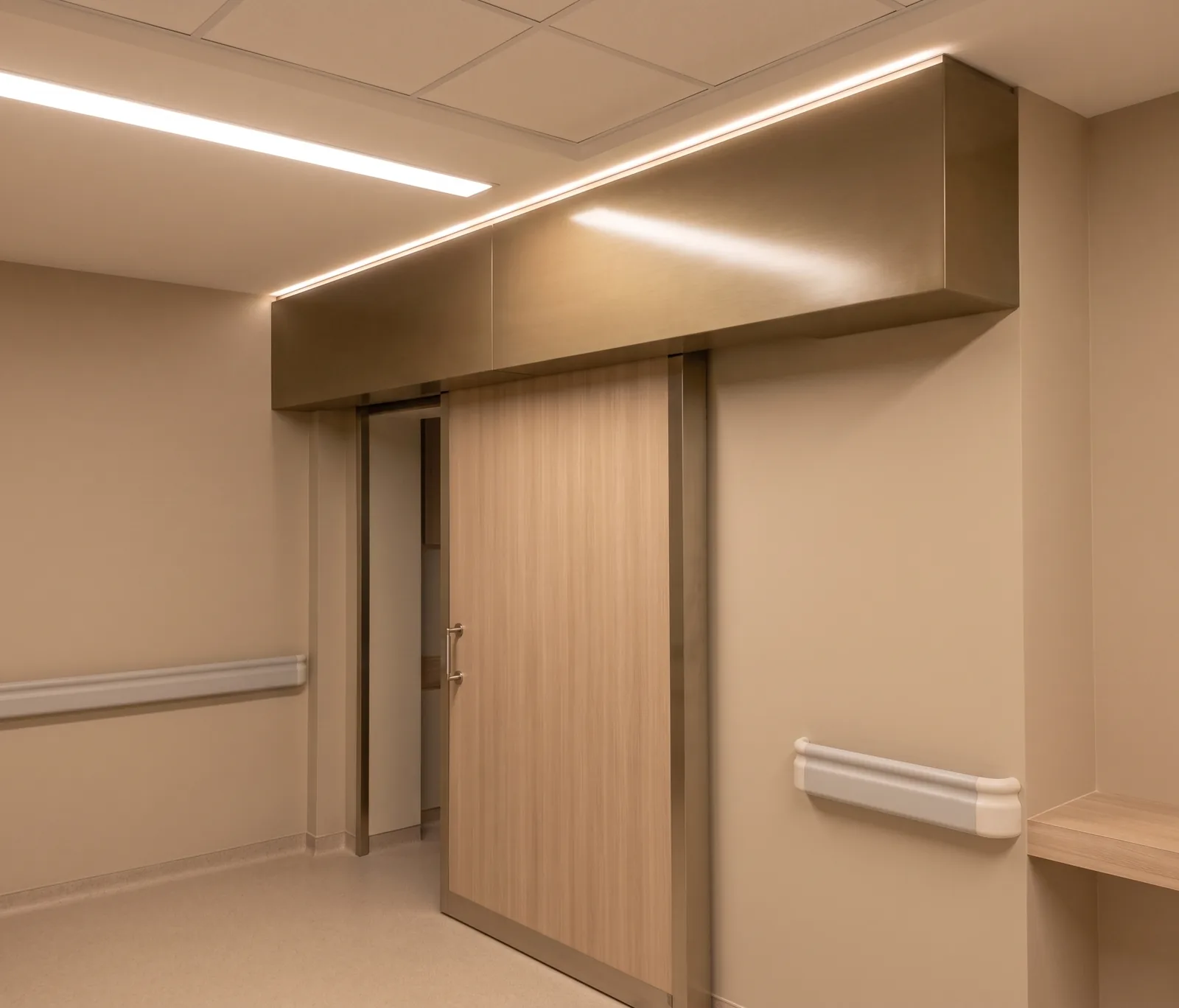
Brachytherapy suites sit inside active clinical departments, often directly on patient corridors. Our brachytherapy doors are engineered to carry their full calculated lead core while looking like part of the interior architecture:
- Wood veneer, laminate and custom color finish options matched to your interior design
- Concealed overhead sliding mechanism or conventional hinged execution
- Compact frame details — the shielding is invisible from the corridor side
- Optional integration of access control readers and status signage
Interlock Integration — The Non-Negotiable Part
International safety guidance for HDR facilities requires the room door to participate in the treatment interlock chain: the source must not leave the afterloader safe while the door is open, and opening the door mid-treatment must retract the source. Our doors are delivered with the position switches and wiring interfaces to integrate with all major afterloader platforms’ door interlock circuits, along with treatment-in-progress warning light control and provisions for the independent radiation monitor at the room entrance required by IAEA guidance.
| Parameter | Typical Configuration |
|---|---|
| Sources covered | Ir-192 · Co-60 HDR afterloaders |
| Shielding core | Continuous lead core, thickness per project calculation |
| Door types | Concealed sliding · hinged single leaf |
| Safety integration | Afterloader door interlock · warning lights · area monitor provisions |
| Finish | Wood veneer, laminate, custom clinical finishes |
| Design basis | NCRP 151 · IAEA safety guidance for HDR brachytherapy · local regulations |
Beyond the Door
Through our treatment room design service we support complete HDR suite projects — wall shielding assessment, maze-versus-direct-door layout decisions for new construction, and conversion of existing rooms (including former LDR or imaging rooms) to HDR use. The door specification then arrives as part of a coherent, calculated whole rather than an isolated component.