A 6 MV Machine That Demands a Heavier Door
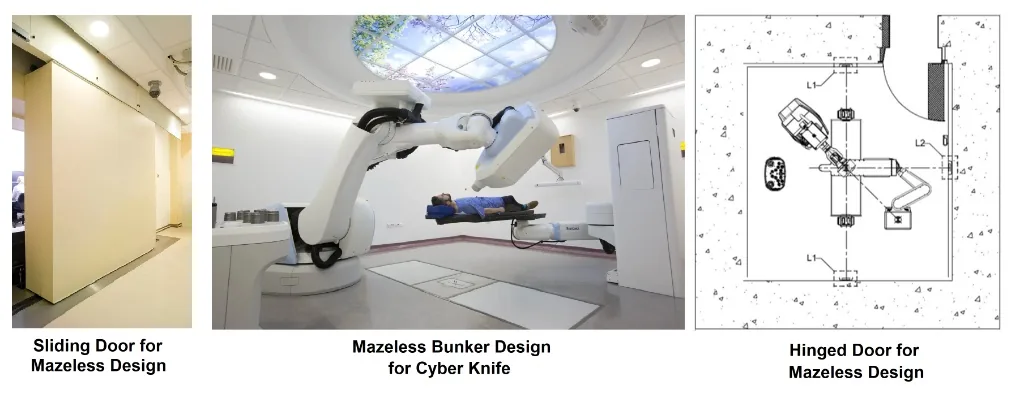
Robotic radiosurgery systems operate at 6 MV — comfortably below the photoneutron threshold — so, as with any low energy machine, the shielding problem is purely photonic. What makes these rooms special is geometry. The robotic manipulator points the beam non-isocentrically across a wide solid angle, so larger wall areas must be treated as potential primary barrier than in a conventional gantry vault. And because radiosurgery rooms are typically compact, they are very often built without a maze — which places the entrance door directly in the scattered radiation field as a direct-shielded barrier.
The practical result surprises many project teams: a 6 MV radiosurgery room frequently needs a substantially heavier door than a 6 MV conventional LINAC vault with a maze. The door’s lead content is doing the work a maze would otherwise do.
Our Engineering Response
- Direct-shielded design — the door is calculated as a full secondary barrier element per NCRP 151, using the room’s actual beam-direction use factors
- Motorized sliding execution — the lead mass of a direct-shielded door makes powered sliding operation the standard choice; PLC control with soft start/stop
- Radiation-tight edge engineering — with the door in the direct scatter field, overlap details at all four edges are calculated, not assumed
- Full safety chain — treatment interlock circuit, anti-crush presence detection, warning light control, battery backup and mechanical manual release
Fitting the Vendor's Site Requirements
We engineer the door around the machine vendor’s site planning requirements and your physicist’s shielding report — clear opening dimensions, interlock interface, and the dose design limits for the area behind the door. Where the project is still at the design stage, our treatment room design service can carry the full room shielding calculation, so the walls, ceiling and door emerge from a single consistent NCRP 151 analysis.
| Parameter | Typical Configuration |
|---|---|
| Machine class | Robotic radiosurgery systems (6 MV, flattening-filter-free) |
| Room layout | Mazeless / short-maze compact vaults → direct-shielded door |
| Shielding core | Continuous lead core in welded steel chassis, per-project calculation |
| Operation | Motorized sliding, PLC-controlled; emergency manual release |
| Neutron layer | Not required at 6 MV — photon shielding only |
| Design basis | NCRP 151 · vendor site planning documents · local regulatory limits |
CyberKnife® is a registered trademark of Accuray Incorporated. MSA Projecta is an independent shielding door manufacturer and is not affiliated with Accuray; our doors are engineered to meet the radiation shielding requirements of robotic radiosurgery installations.