A Machine That Forgives Nothing
A linear accelerator is simultaneously one of the heaviest and one of the most fragile objects in a hospital: multi-tonne assemblies built around waveguides, magnets and precision mechanics that hold sub-millimetre tolerances. Moving one — into a new vault, out of an old one, across a city or across a border — is a project in which a single improvised lift can convert a multi-million-euro asset into scrap, and a single planning gap can stretch a two-week clinical pause into a quarter. This is not general cargo work, and treating it as such is how radiotherapy programs get hurt.
MSA Projecta’s leadership comes from precisely this discipline: Varian-certified extended rigging team leadership and a professional history spanning roughly a thousand accelerator installation projects, more than two hundred of them hands-on. That experience is the service — the ability to see, at the planning table, the door that is 40 millimetres too narrow, the floor that needs load spreading, the customs document that takes six weeks, and to solve each of them before it becomes a stopped crane and an idle vault.
The Full Project Arc
- Feasibility and route survey — site walkthroughs at both ends, transport route verification, crane positioning studies, structural checks on every floor the machine will cross, and a written risk register before anything moves
- Decommissioning — controlled shutdown and disassembly of the outgoing machine in coordination with the vendor, including component protection, documentation and environmentally responsible disposal where the machine retires
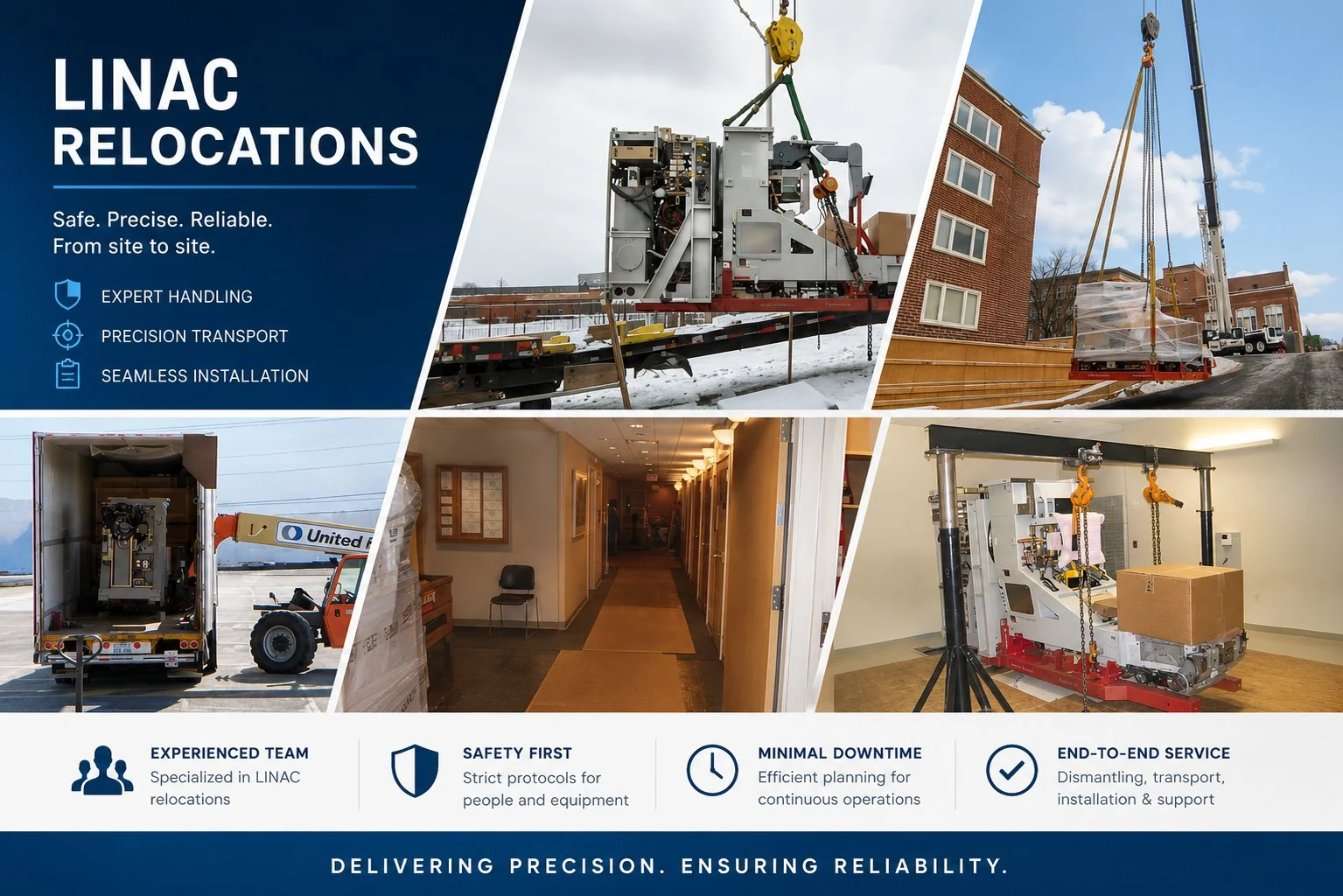
- Rigging and transport — specialized lifting teams, engineered lifting points, climate- and shock-protected transport, and international logistics with customs and import documentation handled end to end
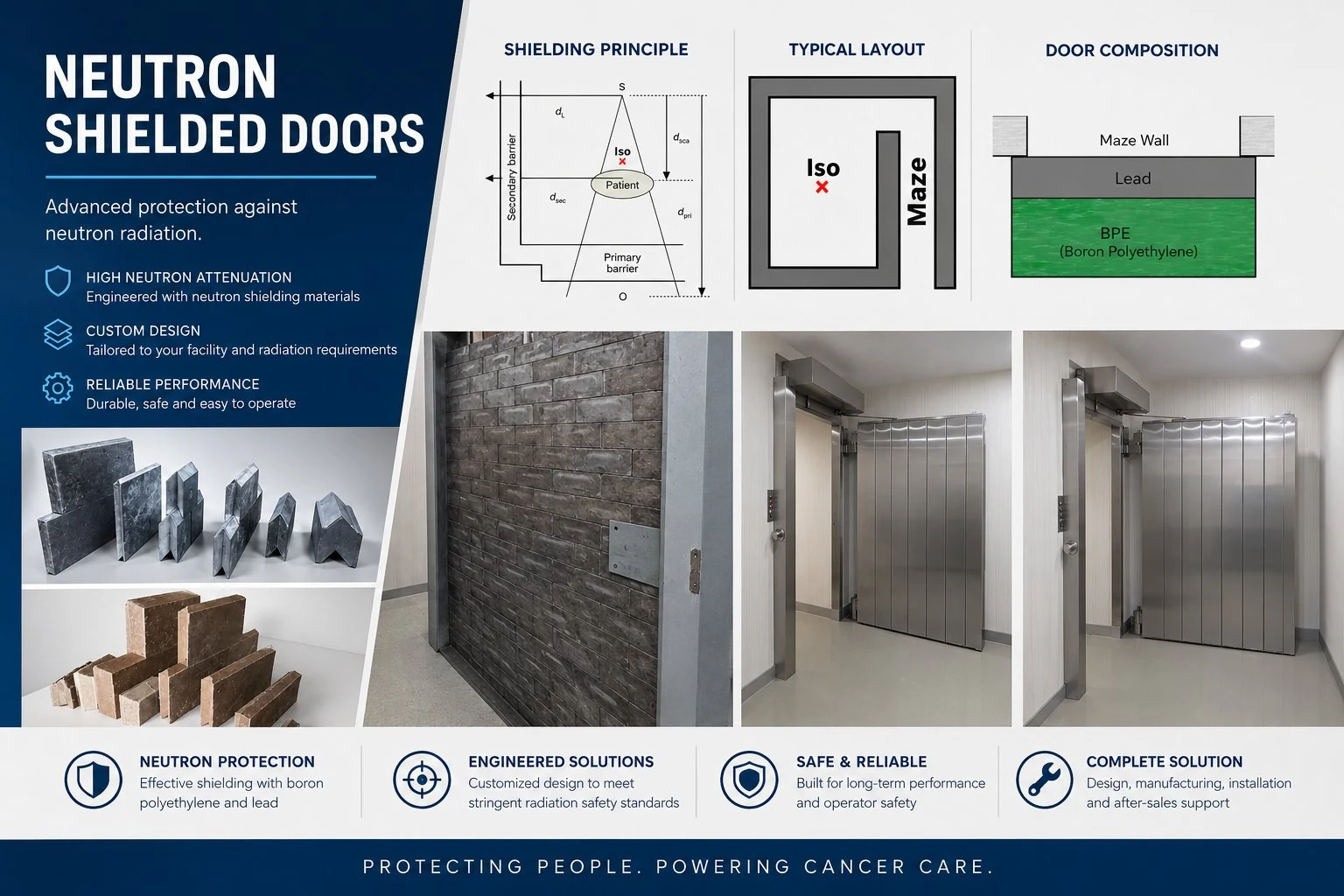
- Vault readiness — shielding modifications, new door supply and installation, chiller and power infrastructure, cable routing and finishing works sequenced so the room is genuinely ready on machine-arrival day, not approximately ready
- Installation support and acceptance — positioning to the vendor’s tolerances, utilities connection, support through vendor installation and calibration, and coordination of acceptance testing until the machine treats
Downtime Is the Real Currency
For a working department, the meaningful metric of a relocation project is not tonnage — it is treatment days lost. Our planning philosophy attacks downtime from both ends: everything that can happen before the clinical pause does happen before it (vault works, door installation, infrastructure, logistics staging), and the pause itself is choreographed hour by hour, with rigging, transport and vendor teams sequenced like a pit stop rather than queued like subcontractors. On multi-machine sites we phase work so remaining vaults keep treating; on single-machine sites we compress the critical path and agree it with the clinic in writing, because a promise about downtime is only worth the plan behind it.
One Table, All the Parties
| Party | What We Coordinate With Them |
|---|---|
| Accelerator vendor | Rigging specifications, installation scheduling, calibration and acceptance sequence |
| Hospital clinical team | Treatment pause windows, patient re-planning horizon, recommissioning dates |
| Hospital technical services | Power, cooling, HVAC and IT readiness; access and safety permits |
| Construction contractor | Vault modifications, embedded frames, finishing works on the critical path |
| Logistics & customs | International transport, import/export documentation, insurance and staging |
| Regulatory authority | License amendments, shielding documentation and commissioning surveys |
Radiotherapy projects rarely fail inside any one of these lanes — they fail between them. Our role is to own the whole table: one project manager, one integrated schedule, one risk register, and one party answerable when any lane slips.
Where This Service Earns Its Keep
Typical engagements include second-hand accelerator relocations between hospitals and across borders; fleet renewals where an old machine exits and a new one enters the same vault inside one compressed window; new-build radiotherapy departments where we carry the machine-side project management alongside our design, door and chiller scopes; and rescue engagements — projects that started without specialist management and stalled. In every case the deliverable is the same: a machine treating patients, on a date that was promised, with an asset and a building undamaged by the journey.
Anatomy of a Machine Swap
A fleet-renewal swap — old accelerator out, new one into the same vault — shows the method at its clearest. Weeks before the clinical pause, the long-lead work happens invisibly: route survey and crane permits closed, vault modification materials staged, the new door (if the project includes one) manufactured and waiting, logistics booked with weather margins. The pause itself opens with vendor-coordinated decommissioning and rigging-out of the old machine; the vault crew takes over immediately for shielding, finishing and infrastructure work while the outgoing unit is still being trucked away; rigging-in follows the moment the room is signed back; and vendor installation, beam calibration and acceptance run on a schedule agreed before the first bolt was loosened. Every day in this sequence is owned by a named party against a clock the clinic has already communicated to its patients — which is the whole difference between a project and an adventure.
The Risk Register You Will Never See Fire
Good project management is mostly the quiet neutralization of risks the client never learns existed. Our standing register for accelerator moves includes the route obstruction discovered on survey rather than on moving day; the crane slot lost to wind, pre-covered by schedule margin; the customs query answered by documentation prepared in advance; the vault snag — an as-built surprise behind old cladding — met with materials already on site; the vendor engineer availability shift absorbed by early slot booking; and the structural query on an aging floor resolved by load-spreading design before anything heavy rolled over it. Each entry carries an owner, a mitigation and a trigger point. The report the hospital receives at the end is pleasantly boring, and that is the deliverable.
Second-Hand Accelerator Projects, Done Honestly
The international market in pre-owned accelerators offers real value and real traps, and the difference is decided before purchase, not after delivery. Our scope on second-hand projects begins at the source machine: condition assessment in coordination with vendor service history, verification that the configuration matches the clinical intent, and a professional deinstallation that preserves the value being paid for — because a machine ruined by careless rigging is ruined regardless of its service record. Transport, storage where schedules demand it, and reinstallation then proceed under the same discipline as a new-machine project, closing with vendor recommissioning and acceptance. For hospitals extending capacity on constrained budgets, a well-executed pre-owned project delivers treating capability at a fraction of new-machine cost — and a badly executed one delivers a very heavy lesson. We exist to make it the former.
Door, Chiller and Machine on One Schedule
The structural reason to place project management with MSA Projecta is integration: the vault door, the cooling plant and the machine logistics are usually three suppliers on three schedules, and their misalignment is where downtime hides. When one engineering partner carries all three, the door installation is sequenced into the same critical path as the rigging window, the chiller is commissioned before the vendor’s engineers need coolant, and no meeting is spent arbitrating whose delay caused whose standstill. Hospitals that have run projects both ways rarely go back to three schedules.
A Cadence the Hospital Can Trust
Management is ultimately communication with a spine. Our projects run on a fixed weekly rhythm: a single-page status against the master schedule, the risk register’s movements, decisions needed and their deadlines — sent whether the news is good or inconvenient. The clinic’s leadership always knows the date it can promise patients and the confidence behind that date; the technical teams always know the week’s critical path; and when something does move, it moves in a report before it moves in a corridor rumour. Two decades in this field have taught us that hospitals forgive difficulty far more readily than surprise — so our method is engineered to produce neither, and to document the first honestly on the rare day it appears.
What the Hospital Keeps When the Project Ends
The final deliverable of a well-managed accelerator project is institutional memory in written form: the as-built dossier with every drawing revision that survived contact with reality, the acceptance and survey documentation the license stands on, the machine’s transport and installation records that its future service life will reference, and a lessons register the hospital owns for its next project. Departments that have this file open their next machine renewal weeks ahead of departments that must first archaeologically reconstruct what was done a decade earlier. We hand it over as a matter of method — because the measure of a project partner is not only the machine treating on the promised date, but what the institution still holds in its hands ten years later.