Why a LINAC Gets Its Own Chiller
A linear accelerator is a thermal machine as much as a radiation machine. The RF power source, the accelerating structure, the target assembly, the bending magnet and the imaging electronics all dump heat continuously — and they demand coolant delivered inside a narrow window of temperature, flow and pressure. Drift outside that window and the consequences climb quickly: RF frequency shifts, beam energy and dose-rate instability, machine interlocks, and ultimately a treatment day lost while a vault full of patients is rescheduled. This is why every accelerator vendor publishes a coolant specification down to the litre per minute, and why the professional answer is a dedicated, closed-loop chiller engineered to that specification — not a tap into whatever the building’s central chilled-water plant happens to supply.
MSA Projecta supplies, installs and commissions dedicated LINAC chillers as part of complete radiotherapy projects and as standalone replacements for aging units — sized machine by machine from the vendor’s site planning data, and delivered with the piping, control and backup provisions that keep a clinical program running.
Low Energy and High Energy Machines Cool Differently
The spread in thermal demand across the LINAC fleet surprises many project teams. A modern single-energy low energy platform and a high-energy stereotactic platform are different machines thermally, not just radiologically — and the vendor site-planning sheets reproduced below show exactly how different.
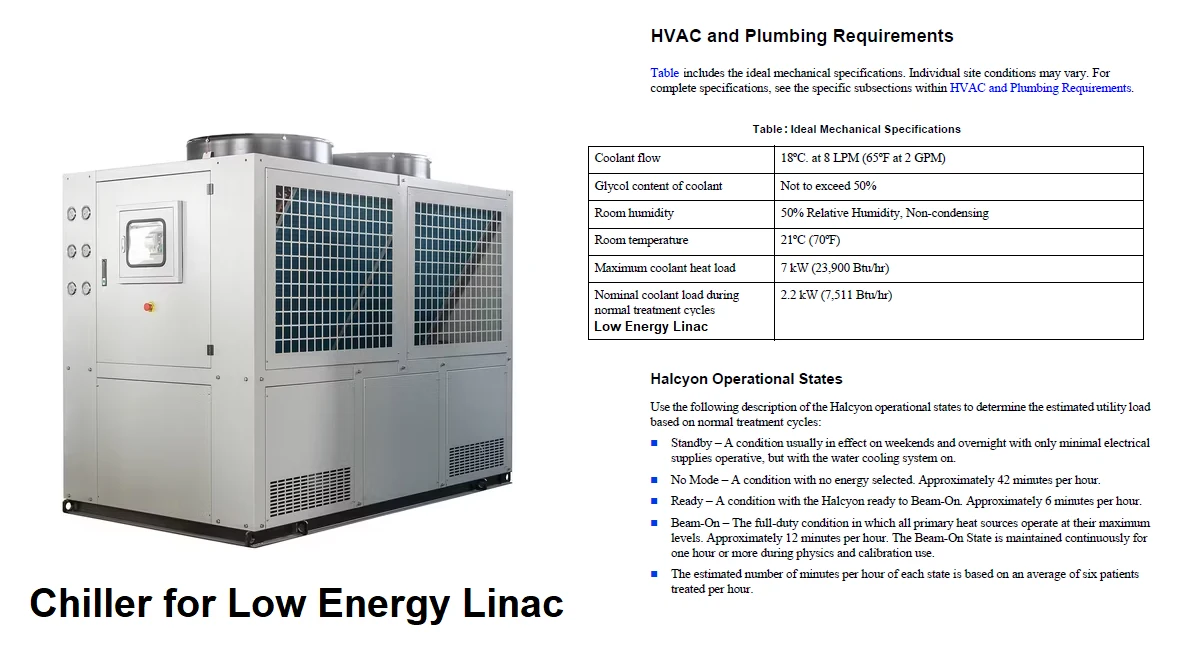
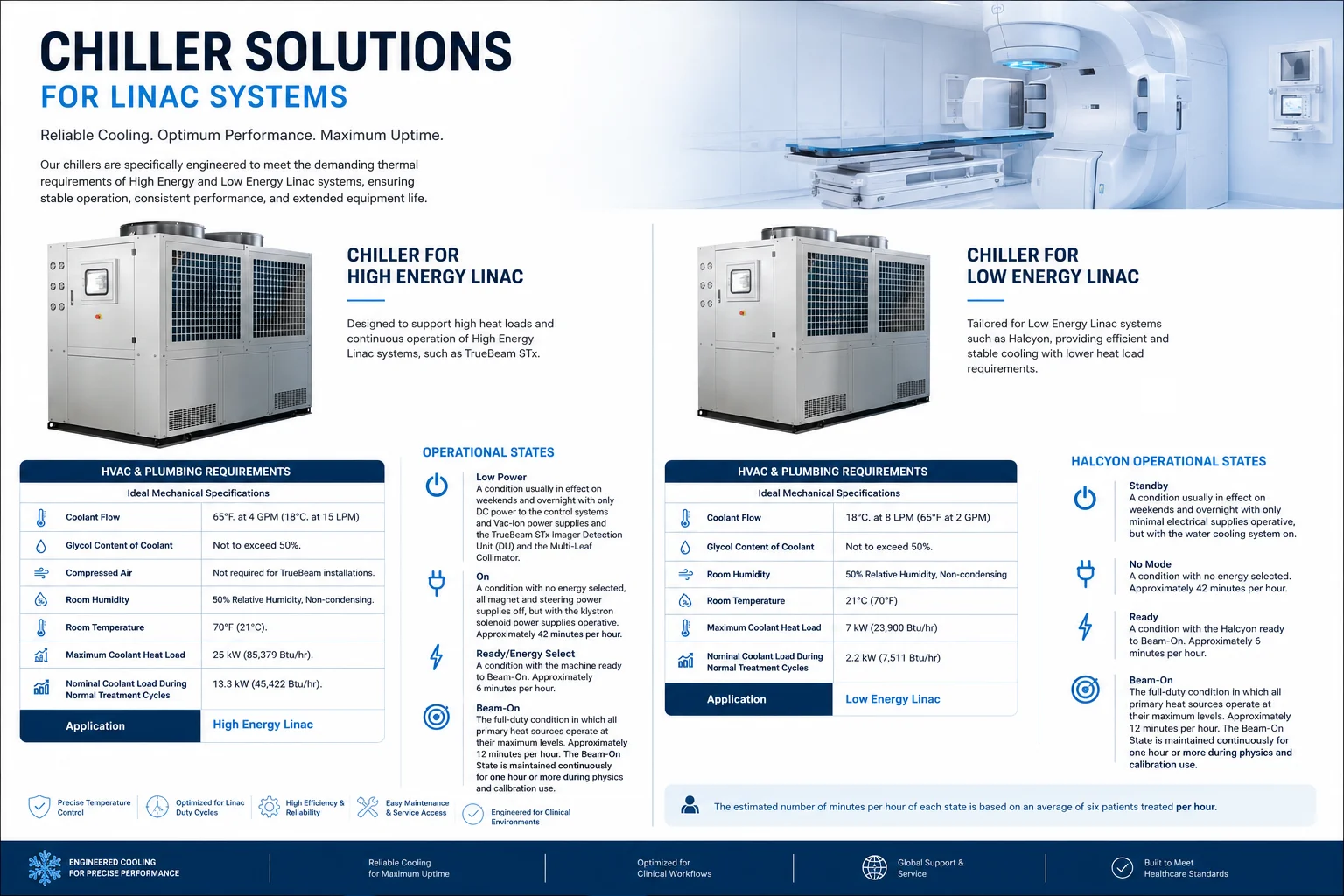
A low energy machine of the Halcyon class asks for a coolant supply of around 8 L/min at 18 °C, with a maximum coolant heat load of 7 kW (23,900 Btu/hr) and a nominal load during normal treatment cycles of just 2.2 kW. Its operational states — standby overnight with only the water cooling system active, roughly 42 minutes per hour in no-mode, short ready intervals and about 12 minutes per hour at beam-on — mean the chiller spends most of its life at partial load, which is precisely where control quality and short-cycling protection matter most.
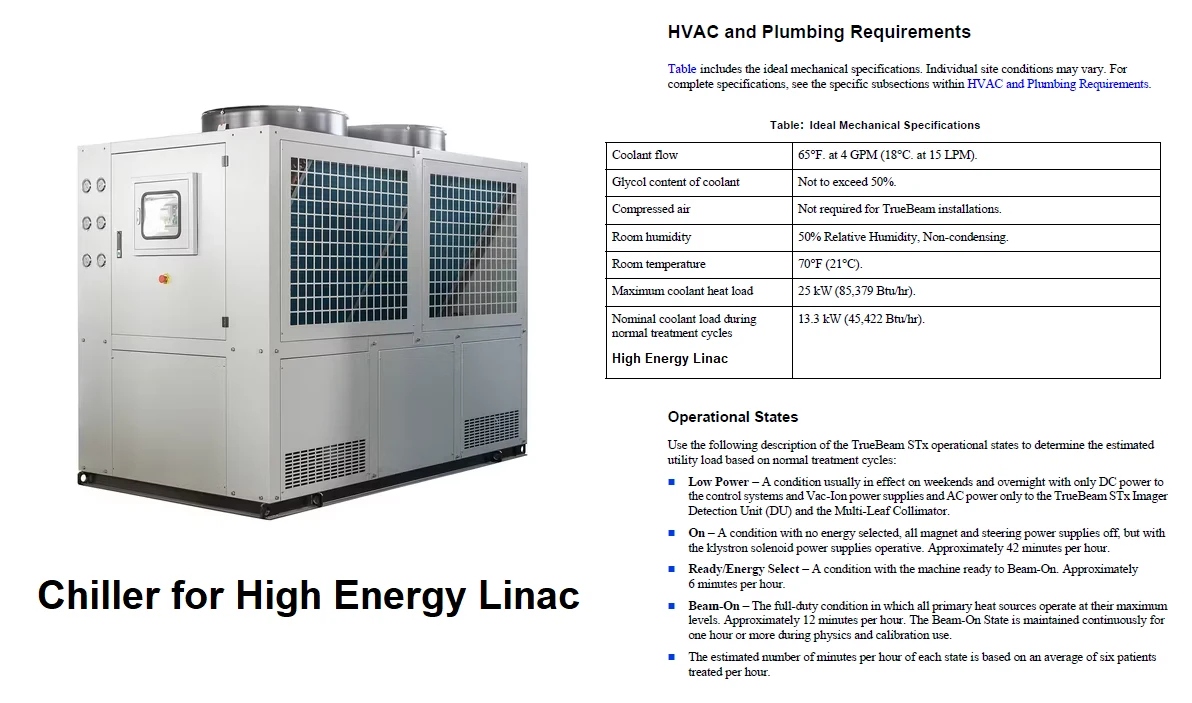
A high energy platform of the TrueBeam STx class is a different animal: roughly 15 L/min at 18 °C (4 GPM at 65 °F), a maximum coolant heat load of 25 kW (85,379 Btu/hr) and a nominal treatment-cycle load of 13.3 kW (45,422 Btu/hr) — with the klystron solenoid supplies keeping a substantial baseline load even between energies, and compressed air not required for TrueBeam installations. Both machine classes share the same non-negotiables: glycol content not exceeding 50%, roughly 21 °C room temperature, 50% non-condensing relative humidity, and 24-hour, year-round cooling duty.
The figures above are the vendor site-planning values for two representative current-generation platforms — your machine’s numbers are taken from its own documentation at design time. The engineering point stands regardless: a chiller sized for a low energy machine will stall a high-energy program, and a grossly oversized unit short-cycles, wastes energy and ages prematurely. Right-sizing against the actual documented heat states — standby, ready and beam-on — is the core of the specification.
What a Properly Engineered LINAC Cooling Loop Includes
- Dedicated closed loop — the accelerator sees only its own treated coolant, isolated from domestic and process water; a plate heat exchanger separates circuits where facility water must be involved
- Temperature control tight enough for RF stability — modulating control that holds the incoming coolant inside the vendor window through every load transition from standby to beam-on, with condensation limits respected
- Flow and pressure discipline — balanced flow at the machine connection, pressure regulation within the vendor’s maximum, flow metering and accessible shut-off valves for service
- Coolant quality management — glycol fraction per specification, and water chemistry (conductivity, dissolved solids, hardness, pH) kept inside the limits that protect the accelerator’s internal heat exchanger from corrosion and scaling
- Correct materials — copper piping and compatible fittings on the machine loop, insulated against condensation
- Monitoring and alarms — temperature, flow and fault signals brought to the technical team before they become machine interlocks
Redundancy: The Cheapest Insurance in Radiotherapy
When a chiller fails, the accelerator protects itself — by refusing to treat. Every hour of cooling failure is an hour of cancelled treatment slots, and in a single-machine center that arithmetic is brutal. We design backup into the cooling concept from the start: duty/standby twin-circuit chillers with automatic changeover where the clinical program justifies it, a valved city-water backup path through the heat exchanger for emergency operation where regulations and water quality allow, and at minimum a maintenance bypass that lets planned service happen without a treatment gap. The right level of redundancy is a clinical-operations decision — we lay out the options with their costs and let the center choose with open eyes.
Installation, Commissioning and the Years After
Supply is the easy half. Our scope covers placement and structural provision (including exterior and rooftop siting with weather protection), piping between chiller and vault with correct routing through shielded penetrations, filling with specified coolant, flow balancing, and commissioning against the accelerator vendor’s checklist — jointly with the vendor’s service engineers, so machine acceptance proceeds without a cooling reservation. Handover includes documentation of the as-built loop and the coolant specification, and we support the years after with maintenance visits, coolant quality checks and replacement planning when a unit approaches end of life.
Because we also manufacture the vault’s shielding doors and manage complete radiotherapy installations, the chiller arrives coordinated with the rest of the project — penetrations shielded correctly, schedules aligned with rigging and machine installation, and one engineering partner answerable for the whole chain.
Water Chemistry: The Silent Machine Killer
Most premature accelerator heat-exchanger failures are not cooling failures at all — they are chemistry failures that took two years to surface. Vendor specifications bound conductivity, total dissolved solids, hardness, chlorides and pH for a reason: outside those bounds, corrosion and scale attack the machine’s internal water paths, and by the time symptoms appear the damage is inside components no one wants to replace. Our commissioning fills the loop with coolant mixed to specification — correct glycol fraction, appropriate inhibitors where the chemistry calls for them — and our maintenance program re-checks the chemistry on schedule, because coolant degrades quietly and drift is cheaper to correct than corrosion. Where local water quality is aggressive, we design the make-up water path accordingly instead of hoping the tap cooperates.
Siting, Noise and the Climate Question
Where the chiller stands matters nearly as much as what it is. Rooftop and exterior siting keeps heat and noise out of the building but exposes the unit to summer extremes and winter freezing — so the specification must carry the real local design temperatures, freeze protection and weather housing, not a temperate-climate catalogue assumption. Technical-room siting protects the unit but demands ventilation for the rejected heat and acoustic planning for the neighbours; a chiller sharing a wall with a treatment control room is a complaint generator unless the acoustics were engineered up front. Pipe runs between chiller and vault are routed, insulated against condensation, and passed through shielded penetrations that respect the vault’s radiation integrity — a detail generic mechanical contractors miss and radiotherapy engineering firms do not.
Signs Your Existing Chiller Is Near the End
Cooling plants rarely die suddenly; they announce themselves. Temperature-related machine interlocks that cluster on hot afternoons; compressors short-cycling; flow alarms that clear on restart; service visits shifting from maintenance to resuscitation; refrigerants that are aging out of regulatory favour — each is the system asking for a replacement plan. The professional response is to plan the changeover on your calendar rather than the failure’s: we survey the existing loop, match the machine’s documented specification, pre-stage the new unit and piping, and execute the swap in treatment-free hours. Centers that replace on schedule buy a chiller; centers that replace on failure buy a chiller plus a week of cancelled treatment slots.
Efficiency: The Bill Nobody Budgets
A LINAC chiller runs every hour of every year, which makes its efficiency a recurring line in the hospital’s energy budget long after the purchase price is forgotten. Right-sizing is the first efficiency measure — an oversized unit short-cycles its way to both wear and waste — and modern scroll compressors, electronically controlled fans and sensible set-point management do the rest. In cooler climates and winter months, favourable ambient conditions can carry a meaningful share of the load when the installation is designed to exploit them. We quantify operating cost expectations in the proposal, because a chiller that saves modestly every day for fifteen years usually beats the one that was merely cheapest on delivery.
One Cooling Partner Across the Machine’s Life
An accelerator changes across its service life — software raises duty cycles, upgrades add imaging load, clinical programs intensify — and its cooling plant must keep answering a question that was first asked at installation. Our relationship with a cooling installation therefore does not end at handover: we hold the as-built loop documentation, track the unit’s service history, reassess capacity when the machine’s configuration changes, and flag replacement horizons before they become emergencies. For multi-vault centers we consolidate this into a single cooling infrastructure picture across all machines — one partner who knows every loop, every coolant specification and every unit’s age, which is precisely the knowledge that turns a 3 a.m. alarm into a managed event instead of a crisis.