Why High Energy Vaults Are a Different Problem
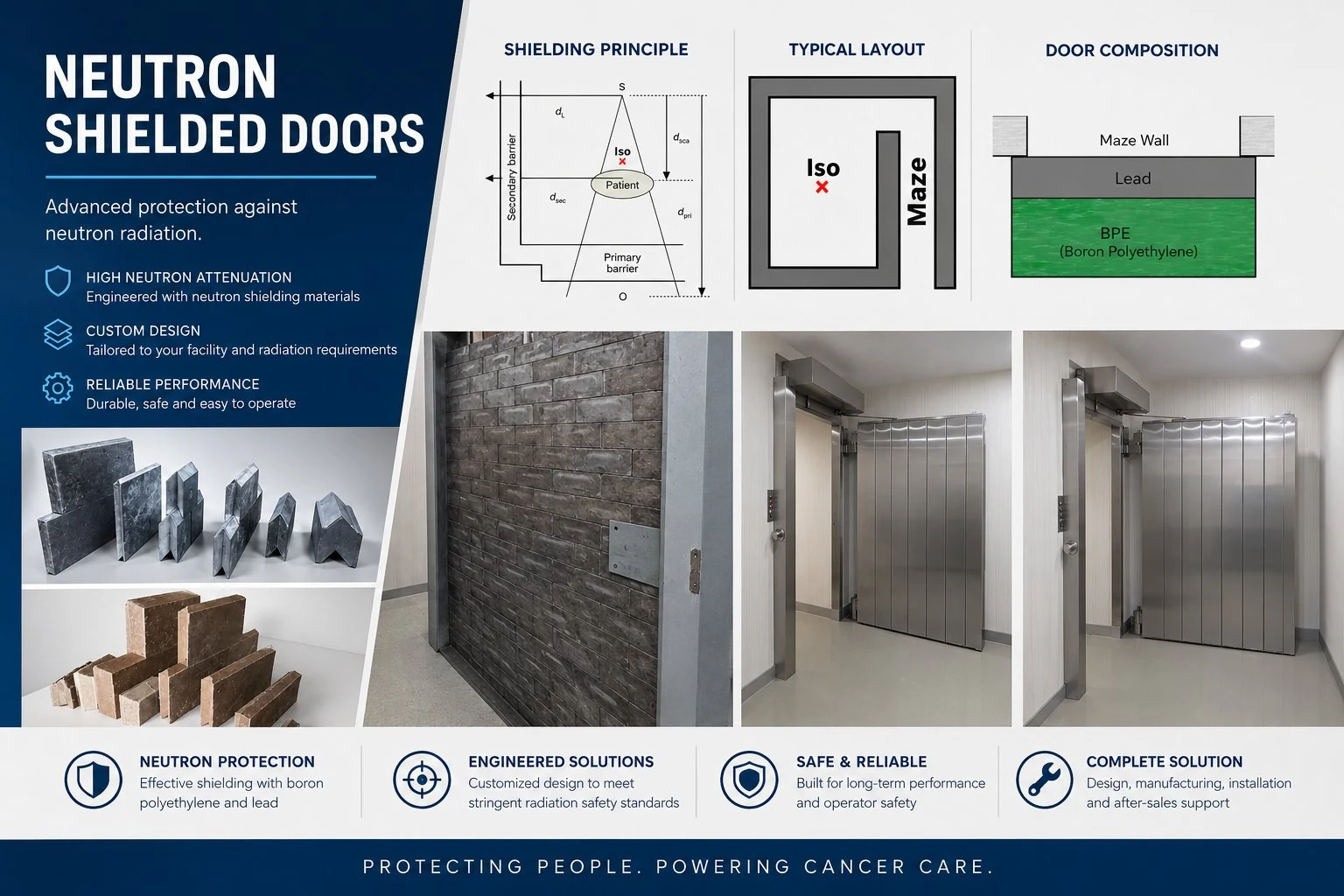
Above roughly 10 MV, the photon beam interacting with the tungsten target, flattening filter, collimators and jaws begins to knock neutrons out of those high-Z materials — photonuclear (γ,n) reactions. These photoneutrons scatter throughout the vault, stream down the maze, and arrive at the door together with the gamma radiation produced when they are captured. A door specified only for photons will simply not protect the corridor behind it. This is the defining engineering challenge of every 15 MV and 18 MV installation.
The Multi-Layer Shielding Principle
An effective neutron door works in sequence, and the order of the layers is not negotiable:
- Moderation — a hydrogen-rich layer of borated polyethylene (BPE) or borated paraffin composite slows fast and epithermal neutrons down to thermal energies through elastic scattering on hydrogen.
- Capture — boron-10 distributed through the same layer absorbs the thermalized neutrons. Boron’s capture reaction emits a comparatively soft 478 keV gamma — far easier to shield than the 2.2 MeV gamma released when hydrogen captures a neutron, which is why the boron content (minimum 5% boric oxide per IAEA guidance) matters.
- Photon attenuation — a lead layer stops the capture gammas together with the scattered photon field arriving down the maze.
- Structure — a welded steel chassis carries the shielding mass and transfers it to the rail or hinge system.
Layer thicknesses are calculated per NCRP Report No. 151 from your vault’s maze geometry, machine workload and the neutron source strength of the specific accelerator model — then verified by measurement after installation.
Engineering for Multi-Tonne Doors
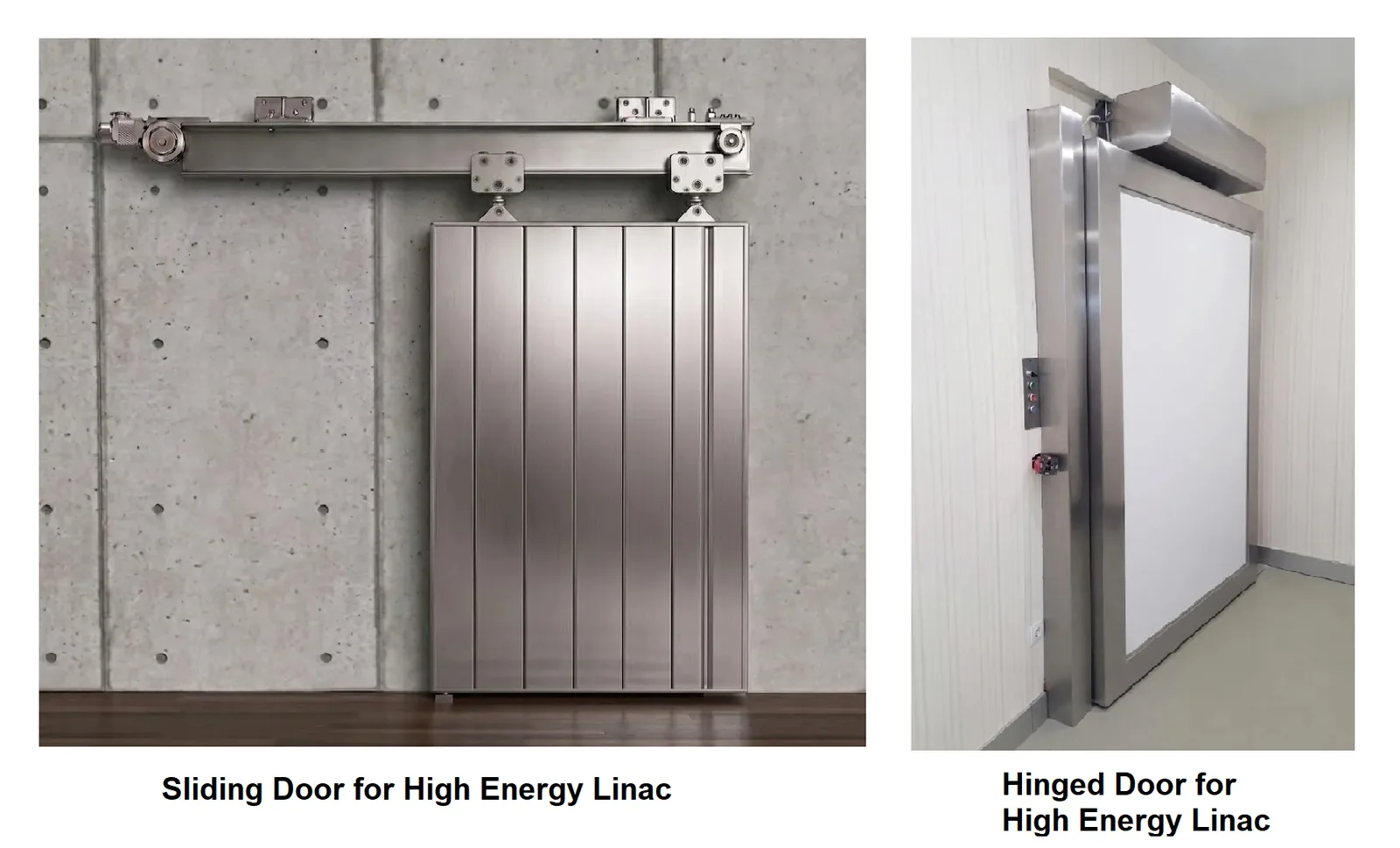
The combined lead and BPE package makes high energy doors heavy — commonly several tonnes depending on the opening size and shielding specification. That mass drives every mechanical decision:
| System | MSA Projecta Approach |
|---|---|
| Drive | Motorized sliding as standard; PLC-controlled soft start/stop |
| Rail & carriage | Rated for the full shielding load with engineering safety margin |
| Sealing | Radiation-tight overlap on all four edges — no direct line-of-sight gap |
| Safety | Anti-crush presence detection, LINAC interlock circuit, audible/visual warnings |
| Power failure | Battery backup plus mechanical manual-release — the room can always be opened |
Verified, Not Assumed
Every high energy door we deliver is commissioned with a radiation survey at the closed door position — photon and neutron dose measurements confirming the installed door meets the calculated design limits before the first patient is treated. The survey report becomes part of your regulatory documentation.