Kilovoltage Shielding — A Lighter but Real Requirement
A CT simulator operates in the kilovoltage range — typically 80–140 kVp — which places its shielding problem in a completely different regime from megavoltage treatment rooms. The radiation reaching the door is scatter from the patient and gantry, and the required attenuation is achieved with millimetres rather than centimetres of lead. Light enough for elegant door engineering; real enough that it must be calculated, not guessed: scanner workload in a busy radiotherapy department is high, and the corridor behind the CT-SIM door is usually a fully occupied area.
We specify CT-SIM door lead linings from your scanner model, projected weekly workload and the occupancy factors of adjacent areas — commonly landing in the range of one to a few millimetres of lead equivalence, with the exact value confirmed in the project shielding report.
Built for an Imaging Suite, Not a Bunker
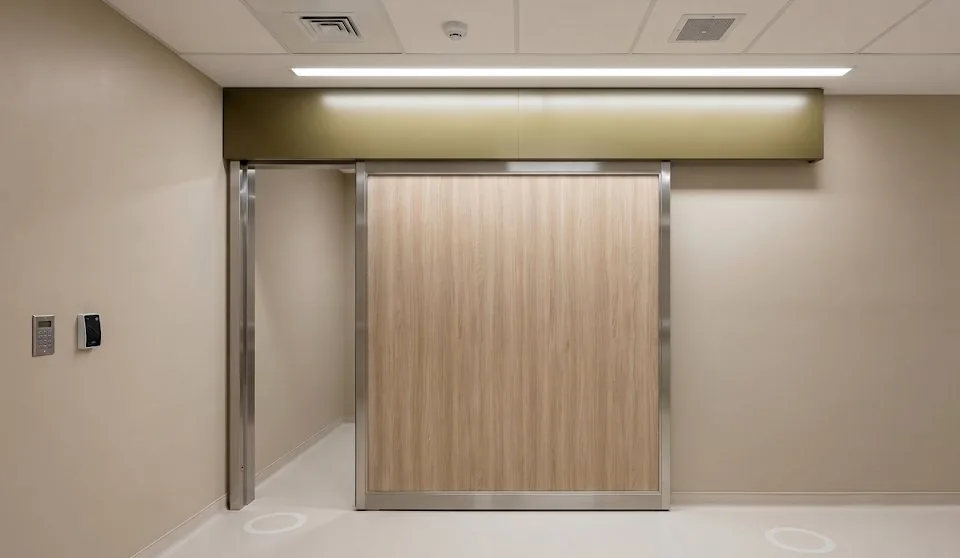
- Architectural finishes — wood veneer, laminate and custom colors matched to the department interior
- Hinged or concealed sliding — standard hinged leaves for most rooms; concealed overhead sliding where corridor space or accessibility requirements demand it
- Lead glass observation window — optional matched-equivalence window integrated into the leaf where the layout benefits from visual contact
- Continuous shielding envelope — lead-wrapped frame details ensure no unshielded gap between leaf, frame and wall lining
- Signage and warning light integration — X-ray in use indicators wired to the scanner room circuit
One Supplier Across the Whole Patient Pathway
In a radiotherapy department the CT-SIM room sits at the start of the same patient pathway that ends at the LINAC vault. Specifying the CT-SIM door, the brachytherapy suite and the treatment room doors through one engineering partner keeps interlock philosophy, finish language and documentation consistent across the department — and gives your project one responsible party for every shielded opening.
| Parameter | Typical Configuration |
|---|---|
| Radiation regime | Kilovoltage scatter (80–140 kVp CT) |
| Shielding | Lead lining, commonly 1–3 mm Pb equivalence per calculation |
| Door types | Hinged single/double leaf · concealed sliding |
| Options | Lead glass window · access control · warning light integration |
| Finish | Wood veneer, laminate, custom clinical finishes |
| Design basis | Project shielding report · scanner vendor site planning · local regulations |