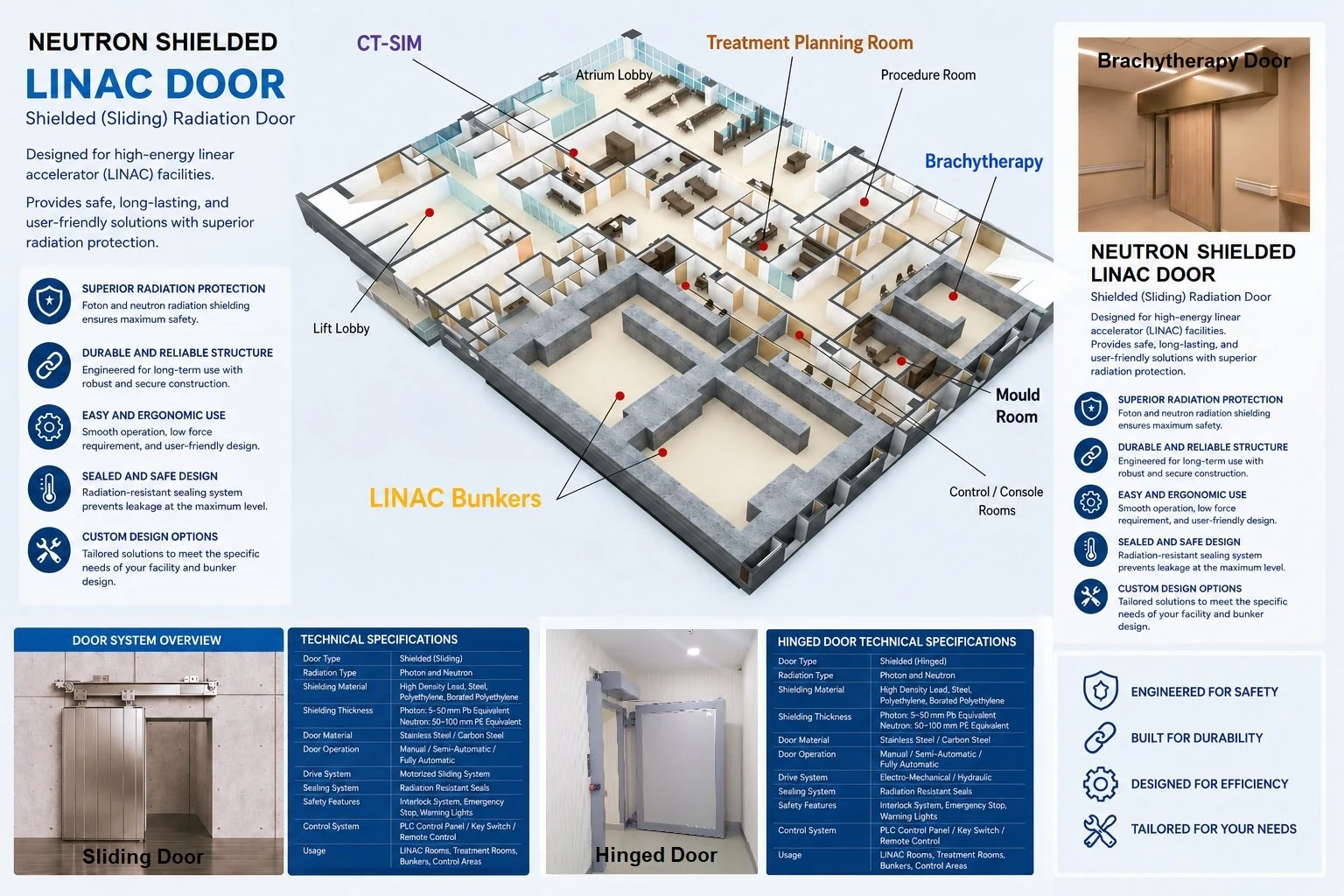
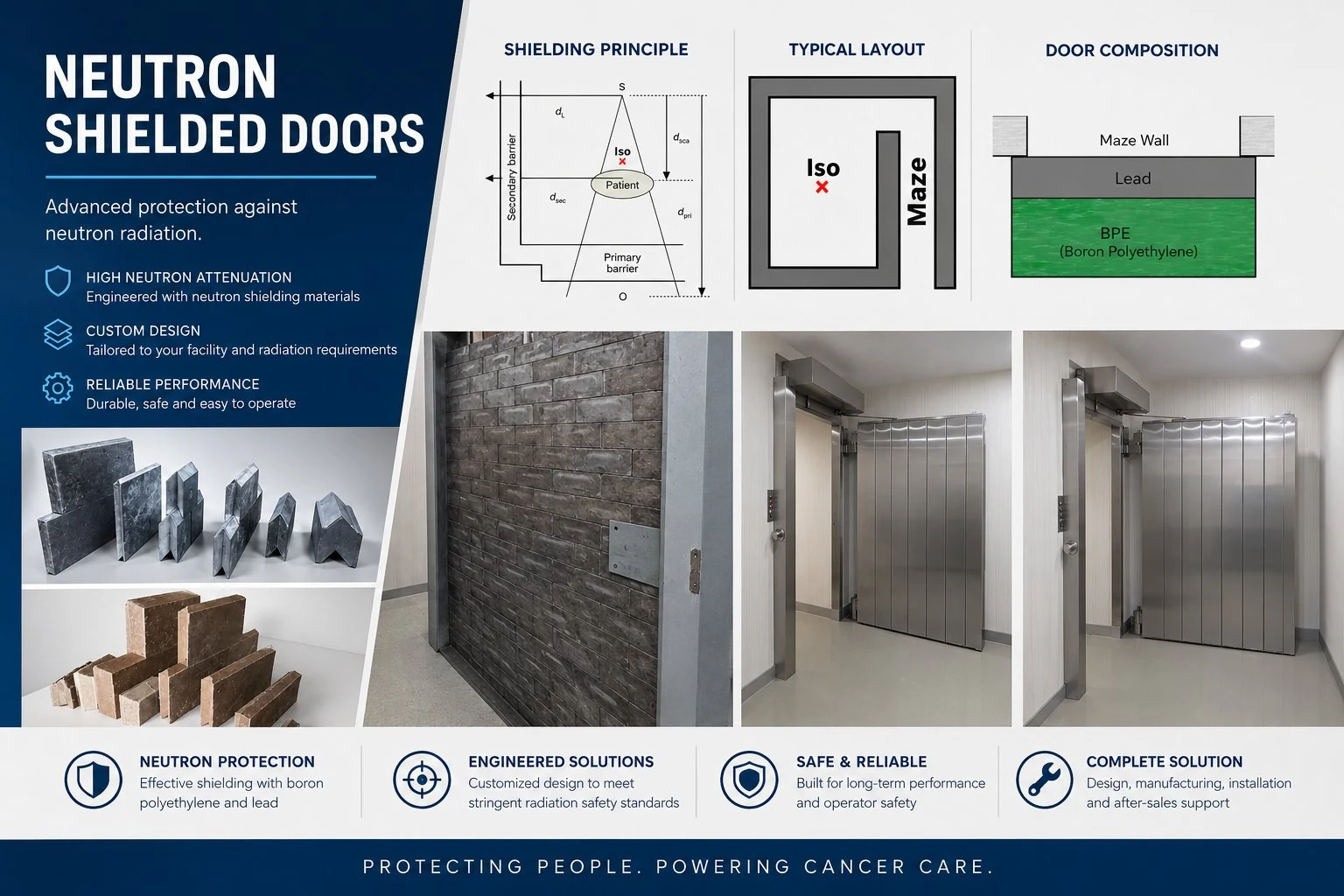
Understanding Photon vs. Neutron Shielding
Choosing the right door begins with understanding the radiation environment. Our engineers perform individual calculations for every project.
Photon (X-Ray & Gamma) Shielding
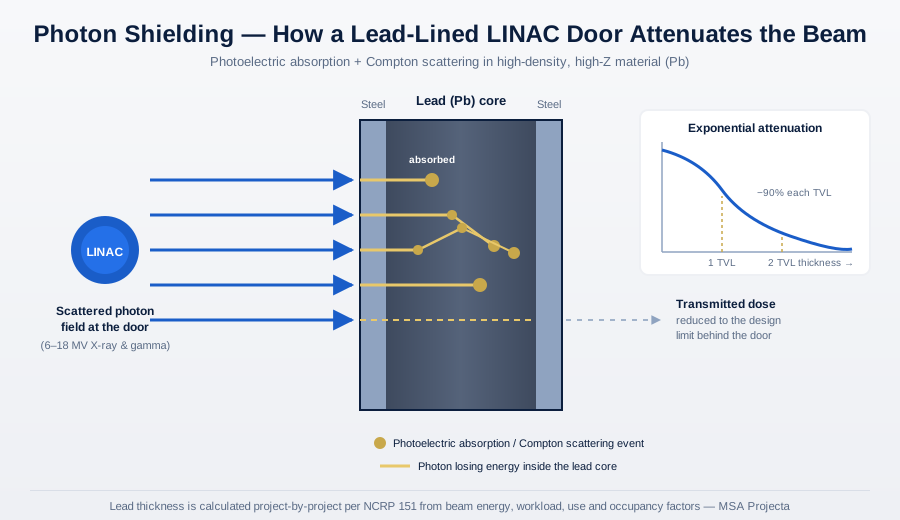
All LINAC systems generate photon radiation — the primary treatment beam and scatter. Photon shielding requires high-density, high-atomic-number materials that absorb and attenuate X-ray and gamma radiation through photoelectric absorption and Compton scattering.
- Required for all LINAC energies (6 MV and above)
- Primary shielding material: lead (Pb)
- Calculated per NCRP 151 primary and secondary barrier methodology
- Thickness: project-specific, based on beam energy and workload
Neutron Shielding
When LINAC beam energy exceeds approximately 10 MV, photoneutron production becomes significant. Neutrons behave differently from photons — they are not attenuated by lead and require dedicated hydrogen-rich and boron-containing materials.
- Required for LINACs operating above 10 MV (15 MV, 18 MV)
- Primary materials: borated polyethylene (BPE), borated paraffin
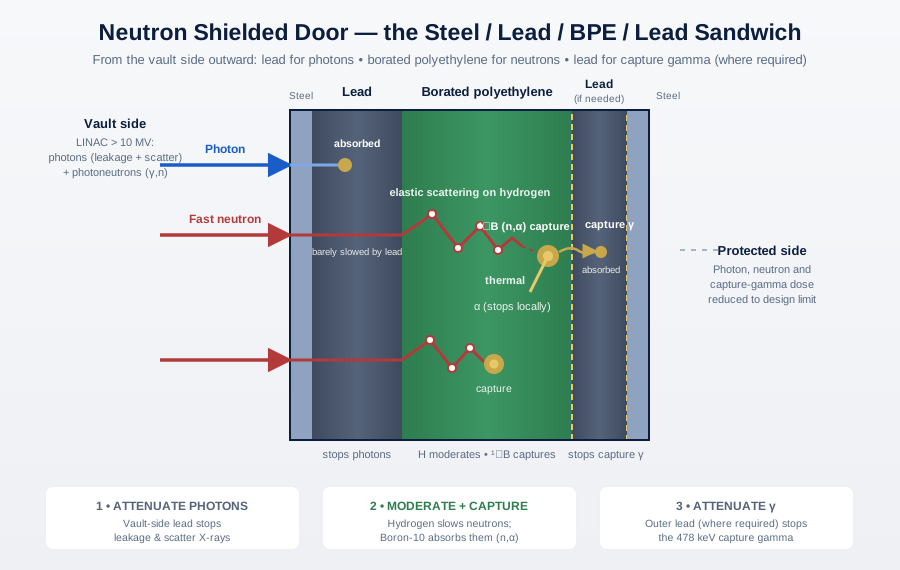
- Boron-10 captures thermal neutrons through (n,α) reaction
- Hydrogen moderates fast neutrons to thermal energies
- Capture gamma radiation also addressed in door design
Photon Shielding for LINAC Doors — In Depth
Every medical linear accelerator, from a single-energy 6 MV machine to an 18 MV high-energy platform, produces photon radiation as its working product. The primary beam is aimed at the patient, but a treatment room is never exposed to the primary beam alone: photons scatter from the patient, from the gantry and collimator assembly, and from the concrete surfaces of the vault itself, while a fraction of the beam leaks through the accelerator head in every direction. The door opening is a deliberate hole in an otherwise continuous concrete barrier, and photon shielding is the discipline of closing that hole so that the dose rate on the far side — where a radiation therapist, a nurse or a member of the public may be standing — never exceeds the limits set by national regulation and international guidance.
ALARA: the Principle Behind Every Millimetre
All structural shielding design answers to a single governing principle: ALARA — keeping every exposure As Low As Reasonably Achievable. Formalised as the optimisation principle of the ICRP system of radiological protection and embedded in IAEA safety standards and national regulations alike, ALARA means that shielding is not designed merely to meet a dose limit, but to push the dose to workers and the public as far below that limit as economic and practical factors reasonably allow. The classic trio of protective measures — less time near the source, more distance from it, and shielding between — converges, in a radiotherapy facility where staff must work metres from an operating accelerator every day, on the third: engineered shielding is the measure that carries the load.
Where people must work in a radiation environment, the best protection available under today's conditions is provided by concrete — not because it is the most effective attenuator per centimetre, but because it is inexpensive, available everywhere, structurally load-bearing and pourable into any geometry. This is why the walls, ceiling and primary barriers of every radiotherapy vault in the world are metres of concrete: where space allows the thickness, concrete delivers the required attenuation at the lowest cost, and its hydrogen content even gives it useful fast-neutron performance in high-energy rooms. Shielding design therefore always starts with concrete and stays with concrete wherever it can.
Where concrete cannot solve the problem — at the door opening that must move, in retrofit projects where wall thickness is fixed, in layouts where floor space does not permit metres of barrier — we substitute engineered materials: steel and lead for the photon component, and borated polyethylene or an equivalent hydrogenous, boron-bearing material for the neutron component. This substitution logic, concrete first and dense engineered laminates only where geometry forces them, is the practical expression of ALARA in facility design, and it is exactly the engineering territory in which MSA Projecta works every day.
Why Lead Is the Reference Material
Photons are attenuated most effectively by materials that combine high physical density with a high atomic number. In the energy range that matters at a LINAC door — largely scattered and leakage radiation that has already lost part of its energy — two interaction mechanisms dominate. In photoelectric absorption, a photon transfers its entire energy to a bound electron and simply ceases to exist; the probability of this event rises steeply with atomic number, which is exactly why lead (Z = 82) outperforms concrete, steel or gypsum thickness-for-thickness. In Compton scattering, the photon survives the collision but leaves with reduced energy and a new direction, and after a handful of such collisions inside a dense absorber it is degraded to the point where photoelectric absorption finishes the job. A lead-lined door leaf is, in effect, a compact arena in which these two processes are given enough material to run to completion.
Lead earns its place at the door for a further, practical reason: geometry. A vault wall can be 1–2 metres of concrete because nothing has to move; a door has to open several times per treatment slot, every working day, for decades. Achieving the same attenuation in a moving leaf demands the densest practical material, and lead delivers roughly five times the photon attenuation of ordinary concrete per unit thickness. This is what keeps a properly engineered sliding or hinged LINAC door within a weight and thickness envelope that motorized hardware can drive reliably.
Tenth-Value Layers and the Logic of the Calculation
Shielding physics describes attenuation exponentially. Each tenth-value layer (TVL) of a material reduces the transmitted photon intensity to one tenth; two TVLs to one hundredth; three to one thousandth. The TVL of lead depends on the photon energy spectrum striking the door, which is why the same nominal machine can require different door build-ups in different room layouts: a direct-shielded (mazeless) door facing the vault interior sees a harder spectrum and a higher fluence than a door placed at the end of a properly designed maze, where multiple wall scatters have already softened and diluted the radiation.
The internationally accepted calculation framework is NCRP Report No. 151, complemented by IAEA Safety Reports Series No. 47. The methodology is systematic: define the workload (how much radiation the machine delivers per week, including quality assurance and the higher effective workloads of IMRT and VMAT delivery), the use factor (how often the beam points toward each barrier), and the occupancy factor of the space behind the door (a corridor, a control area, an office). From these, the required transmission factor is derived against the design dose limits for controlled and uncontrolled areas, and the transmission factor is converted into millimetres of lead using energy-appropriate TVL data. The result is never a catalogue figure — it is a project-specific number, and at MSA Projecta every door we engineer starts from exactly this calculation, performed for the actual room, the actual machine and the actual clinical program.
From Calculation to a Buildable Door
A calculated lead thickness only protects people if the physical door reproduces it everywhere, without gaps. Lead is dense but soft; it creeps under its own weight if unsupported. Our door leaves therefore carry the lead as interlocked sheets inside a welded steel frame, with the steel skins themselves contributing to the photon attenuation budget. Joints between lead sheets are stepped or overlapped so that no straight-line radiation path exists through the leaf, and the same principle governs the door perimeter: the leaf overlaps the wall opening on all four sides, and the frame region is engineered so that scattered photons cannot stream through the clearance gap needed for movement. Cable penetrations, view windows where specified, and fixings are individually detailed, because a single unshielded bolt hole can undo millimetres of carefully calculated lead.
Weight management is the other half of buildability. A low-energy LINAC door may carry a comparatively modest lead build-up; a high-workload, mazeless high-energy door can weigh many tonnes once its full shielding sandwich is assembled. The photon shielding requirement therefore drives the structural design — track and floor loading for sliding doors, hinge and lintel loading for swing doors — and the motor, gearbox and safety-edge selection follow from the mass. This is why photon shielding cannot be treated as a material order; it is the starting point of the door's entire mechanical engineering.
Verification: Proving the Door, Not Assuming It
Because the shielding is hidden inside the finished leaf, quality assurance has to happen at the right moments. Material certificates confirm the purity and density of the lead; in-process inspection confirms sheet thickness, overlap and coverage before the leaf is closed; and after installation, a radiation survey with the machine operating measures the dose rate around the closed door, across its surface and along its perimeter, confirming that the as-built door meets the design transmission. The survey report becomes part of the facility's regulatory licensing file. For hospitals this final step is not bureaucracy — it is the documented evidence that the opening in the vault wall has genuinely been closed. Explore our practical guide to photon shielding for LINAC facilities, or request a project-specific shielding assessment from our engineering team.
Neutron Shielding for High-Energy LINAC Doors — In Depth
When a linear accelerator operates above approximately 10 MV, a second radiation problem appears alongside the photon field: neutrons. High-energy photons interacting with the high-atomic-number materials of the accelerator head — the tungsten target, the collimator jaws, the flattening filter — exceed the binding energy of neutrons in those nuclei and knock them free through photonuclear (γ,n) reactions. These photoneutrons are emitted in all directions, scatter around the vault with little respect for room geometry, and concentrate at exactly the place the photon design already identified as the weak point: the door opening. This is why 15 MV and 18 MV installations, and increasingly any mazeless high-energy room, require a door that is engineered as a neutron shield first and a photon shield second.
Why Lead Alone Fails Against Neutrons
The instinctive answer — add more lead — does not work, and understanding why is the foundation of correct door design. Neutrons carry no electric charge, so the electromagnetic interactions that make lead so effective against photons simply do not apply. A fast neutron passing through lead scatters off heavy nuclei almost elastically, like a tennis ball bouncing off a wall, losing almost no energy per collision. What slows a neutron efficiently is a collision partner of similar mass: the hydrogen nucleus, a single proton. In a head-on collision with hydrogen a neutron can lose essentially all of its energy in one event, and on average it sheds half its energy per collision. Hydrogen-rich materials — polyethylene above all, with borated paraffin as a historical alternative — are therefore the moderating heart of every neutron door.
The Three-Step Physics of a Neutron Door
A correctly engineered neutron door executes a three-step sequence, and each step dictates a layer of the door's internal sandwich. Step one is moderation: fast and intermediate-energy neutrons entering the hydrogenous layer scatter repeatedly off hydrogen nuclei, cascading down in energy until they reach thermal equilibrium with the material — so-called thermal neutrons, carrying only a fraction of an electron-volt. Step two is capture: a thermal neutron drifting through ordinary polyethylene would eventually be captured by hydrogen itself, but hydrogen capture emits a penetrating 2.2 MeV gamma ray, which would trade one radiation problem for another. This is why the polyethylene is borated. The Boron-10 isotope has an enormous appetite for thermal neutrons — a capture cross-section thousands of times that of hydrogen — and its (n,α) reaction absorbs the neutron while emitting an alpha particle that stops within micrometres, depositing its energy harmlessly inside the material. Step three addresses the remainder: a fraction of Boron-10 captures leaves the residual nucleus in an excited state that de-excites by emitting a 478 keV gamma photon. This capture gamma is far softer than hydrogen's 2.2 MeV line, and where the calculation requires it, a modest thickness of lead positioned on the protected side of the borated polyethylene absorbs it efficiently. The finished leaf is therefore a deliberate sequence, from the vault side outward: steel skin, lead for the photon component, hydrogen-rich borated polyethylene for the neutrons, a further lead layer where the capture-gamma assessment demands it, and the outer steel skin — every layer with a named physical job. The vault-side lead comes first for a reason: in a direct-shielded door the photon component (head leakage and scatter) is the dominant dose contributor and lead barely slows neutrons, so the neutrons pass through to the hydrogenous layer that is actually built for them.
Designing to the Real Neutron Environment
How much borated polyethylene a specific door needs is not a catalogue decision. The neutron fluence at the door position depends on the machine's neutron source strength (published per model and energy), the vault geometry, and above all on whether a maze exists. A well-designed maze is itself a neutron filter: every scatter off a concrete surface both attenuates the neutron fluence and shifts its spectrum toward thermal energies, so a door at the end of a long maze faces a softer, weaker field than the vault-facing leaf of a mazeless room. Direct-shielded doors in compact modern layouts therefore carry substantially heavier neutron build-ups, and the calculation methods of NCRP 151 and IAEA Safety Reports Series No. 47 — Kersey's method and its refinements for the maze-scattered neutron dose, source-strength scaling for the direct component — are applied project by project. At MSA Projecta these calculations, together with the capture-gamma assessment, define the layer recipe of every high-energy door we build; two hospitals with the same accelerator model can correctly receive two different doors.
The opposite case matters just as much in practice. A facility upgrading from a 6 MV single-energy platform to a dual- or triple-energy machine crosses the photoneutron threshold, and its existing photon-only door — however heavy — is no longer adequate. Retrofit projects of this kind are among the most common we encounter: the shielding calculation is repeated for the new energy configuration, the door is re-engineered or replaced with the correct neutron sandwich, and the room re-enters clinical service with its licensing documentation updated. Recognising early in machine procurement that the door is part of the energy decision saves hospitals both budget surprises and installation delays.
Materials, Quality and the Details That Decide Performance
Borated polyethylene is specified by its boron content — typically a defined percentage by weight, verified by material certificates — and by its density and dimensional stability, because a moderating layer only works if it is physically continuous. Panel joints are stepped so no unmoderated straight path exists through the leaf; edge closures, cable routes and the door perimeter are detailed against neutron streaming, which exploits gaps far more aggressively than photons do because scattered neutrons arrive from every direction. The perimeter overlap geometry of the leaf against the wall opening, proven in the photon design, is re-examined for neutrons with the clearance gaps treated as potential ducts. Weight, again, shapes the machinery: the combination of neutron and photon layers makes high-energy door leaves the heaviest moving elements in the building, and drive systems, guides, safety edges and emergency manual operation are engineered around that mass for a decades-long service life.
Finally, the proof is measured, not assumed. Commissioning of a neutron-shielded door includes both photon and neutron surveys around the closed leaf at the machine's highest clinical energy, using instruments appropriate to each field, with results documented for the facility's licensing file. This closes the engineering loop: calculated, built, and verified. Read the full guide to high-energy LINAC shielding design, see how neutron shielded doors are designed, or contact our engineers to review your vault layout and energy configuration.