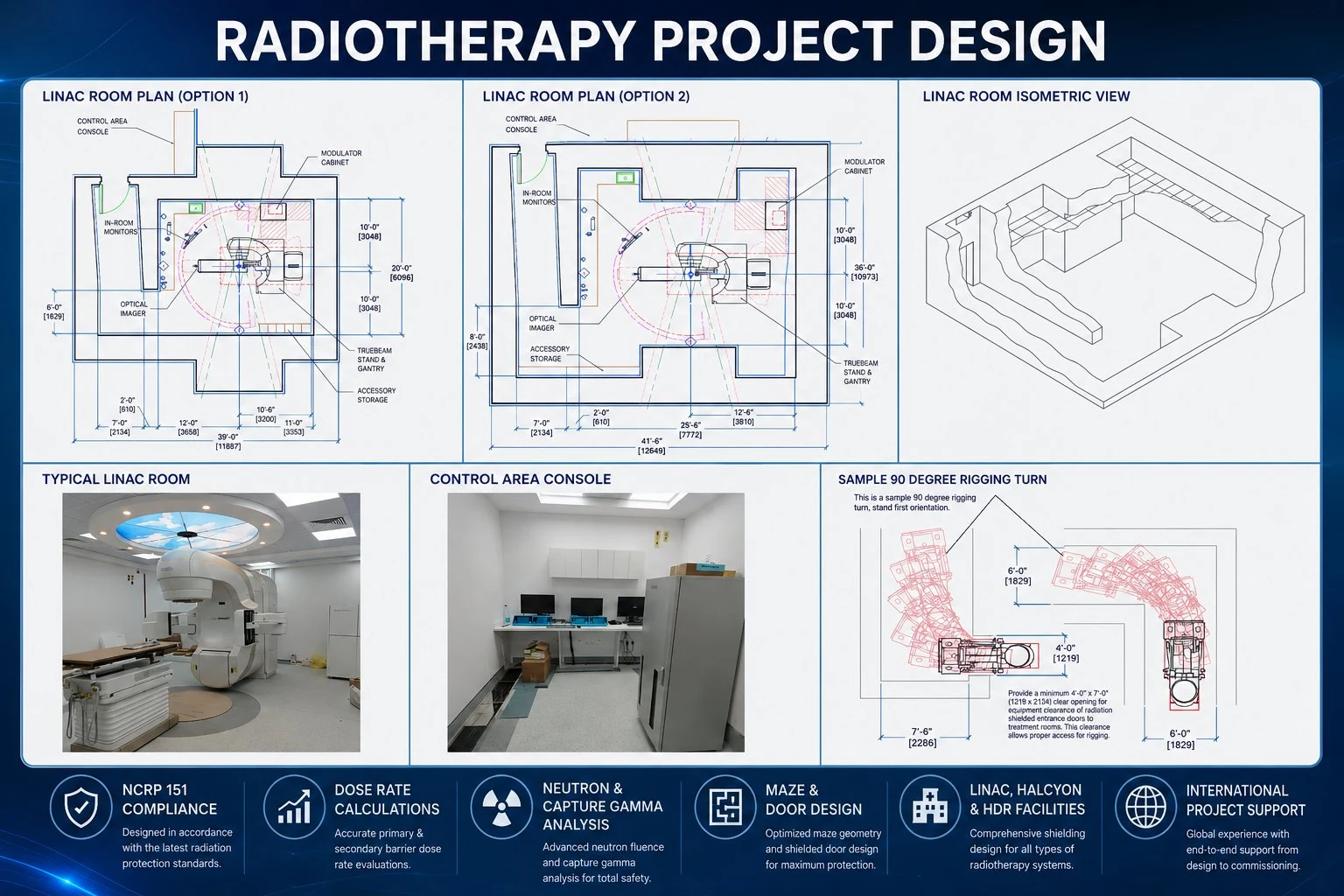
Understanding NCRP 151 in Modern Radiation Oncology Facilities
When designing a radiotherapy treatment facility, radiation safety is one of the most critical engineering considerations. Among all international guidance documents, NCRP Report No. 151 has become the most widely referenced standard for the shielding design of medical linear accelerators (LINACs), radiotherapy bunkers, and radiation treatment rooms.
For hospitals, cancer centers, architects, medical physicists, and radiation shielding specialists, understanding NCRP 151 Shielding Requirements is essential to ensure regulatory compliance, operational safety, and long-term facility performance.
What Is NCRP Report No. 151?
NCRP Report No. 151, published by the National Council on Radiation Protection and Measurements, provides comprehensive guidance for the shielding design and evaluation of megavoltage X-ray and gamma-ray radiotherapy facilities.
The report serves as a practical framework for:
- Linear accelerator bunker design
- Radiation shielding calculations
- Primary barrier design
- Secondary barrier design
- Neutron shielding requirements
- Maze design optimization
- Shielding door specifications
- Occupancy and workload assessments
Today, NCRP 151 is widely used as a reference document for radiotherapy projects throughout North America, Europe, the Middle East, Asia, and many other regions.
Why NCRP 151 Is Important
Radiotherapy systems operating at high energies generate significant levels of radiation that must be controlled to protect:
- Radiation therapists
- Medical physicists
- Hospital staff
- Patients
- Visitors
- Adjacent building occupants
NCRP 151 provides methodologies that help engineers and physicists calculate the required shielding thicknesses for walls, ceilings, floors, mazes, and treatment room doors.
A properly designed bunker based on NCRP 151 recommendations minimizes radiation exposure while optimizing construction costs and facility efficiency.
Key Shielding Design Parameters in NCRP 151
Workload (W)
Workload represents the total amount of radiation delivered by the treatment machine over a specified period. Higher patient volumes and advanced treatment techniques often require increased shielding considerations.
Use Factor (U)
The use factor accounts for the fraction of time the primary beam is directed toward a particular barrier. Different walls within the treatment room may receive varying levels of exposure depending on treatment practices.
Occupancy Factor (T)
Occupancy factor reflects how frequently adjacent spaces are occupied.
Examples include:
- Offices
- Control rooms
- Public corridors
- Waiting areas
- Technical rooms
Areas with continuous occupancy require more stringent shielding protection.
Distance (d)
Radiation intensity decreases with distance according to the inverse square law. Accurate distance measurements are therefore essential when calculating shielding requirements.
Primary and Secondary Barriers
Primary Barriers
Primary barriers are designed to intercept the direct treatment beam.
Typical primary barriers include:
- Treatment room walls
- Floors
- Ceilings
These structures often require substantial concrete thicknesses due to the intensity of the primary beam.
Secondary Barriers
Secondary barriers protect against:
- Leakage radiation
- Patient scatter radiation
Although secondary barriers typically require less shielding than primary barriers, they remain critical components of overall bunker safety.
Neutron Shielding Requirements for High-Energy LINACs
One of the most important contributions of NCRP 151 is its guidance on neutron shielding for accelerators operating above 10 MV. At these energies, photoneutron production becomes a significant design consideration.
Common neutron shielding materials include:
- Borated polyethylene
- Borated paraffin
- Hydrogen-rich shielding composites
Neutron protection is particularly important near:
- Maze entrances
- Shielding doors
- Occupied areas adjacent to treatment rooms
Proper neutron attenuation reduces both radiation exposure and activation concerns.
Maze Design and Shielding Door Optimization
An efficient maze design can significantly reduce radiation levels at the treatment room entrance.
Benefits include:
- Lower door shielding requirements
- Reduced door weight
- Lower installation costs
- Improved operational efficiency
NCRP 151 emphasizes the importance of evaluating maze geometry before determining final shielding door specifications. For many high-energy LINAC facilities, a carefully engineered combination of maze design and radiation shielding doors provides the most cost-effective solution.
Radiation Shielding Doors According to NCRP 151
Radiotherapy bunker doors must be designed based on the calculated radiation levels at the maze entrance.
Depending on beam energy and bunker configuration, doors may incorporate:
- Lead shielding for photon attenuation
- Borated neutron shielding materials
- Steel structural reinforcement
- Radiation-tight sealing systems
Each project requires site-specific calculations to determine the optimal shielding configuration.
Common Challenges in NCRP 151 Shielding Projects
While the report provides a robust framework, practical implementation often presents challenges such as:
- Limited construction space
- Existing building constraints
- Complex bunker geometries
- High-energy accelerator requirements
- Future equipment upgrades
- Budget optimization goals
These factors require experienced engineering teams capable of balancing safety, compliance, and constructability.
Why Professional Shielding Design Matters
Radiotherapy bunker shielding is not simply a construction exercise—it is a highly specialized engineering discipline combining:
- Radiation physics
- Structural engineering
- Mechanical design
- Clinical workflow planning
- Regulatory compliance
A professionally designed shielding solution can reduce construction costs, improve operational efficiency, and ensure long-term regulatory acceptance.
Conclusion
NCRP 151 Shielding Requirements remain the global benchmark for radiotherapy bunker design and radiation protection engineering. By addressing workload, occupancy, beam energy, neutron production, and shielding geometry, the report provides a comprehensive methodology for creating safe and efficient treatment facilities.
Whether planning a new cancer center, upgrading an existing LINAC bunker, or evaluating radiation shielding doors and neutron protection systems, applying NCRP 151 principles is essential for achieving the highest standards of safety and performance.
Successful projects begin with accurate calculations, experienced engineering expertise, and a commitment to delivering compliant, future-ready radiotherapy facilities.
Planning a radiotherapy shielding project?
Our engineers respond to technical inquiries within one business day — shielding calculations, door specifications and full project quotations.
Request a Technical Quote →