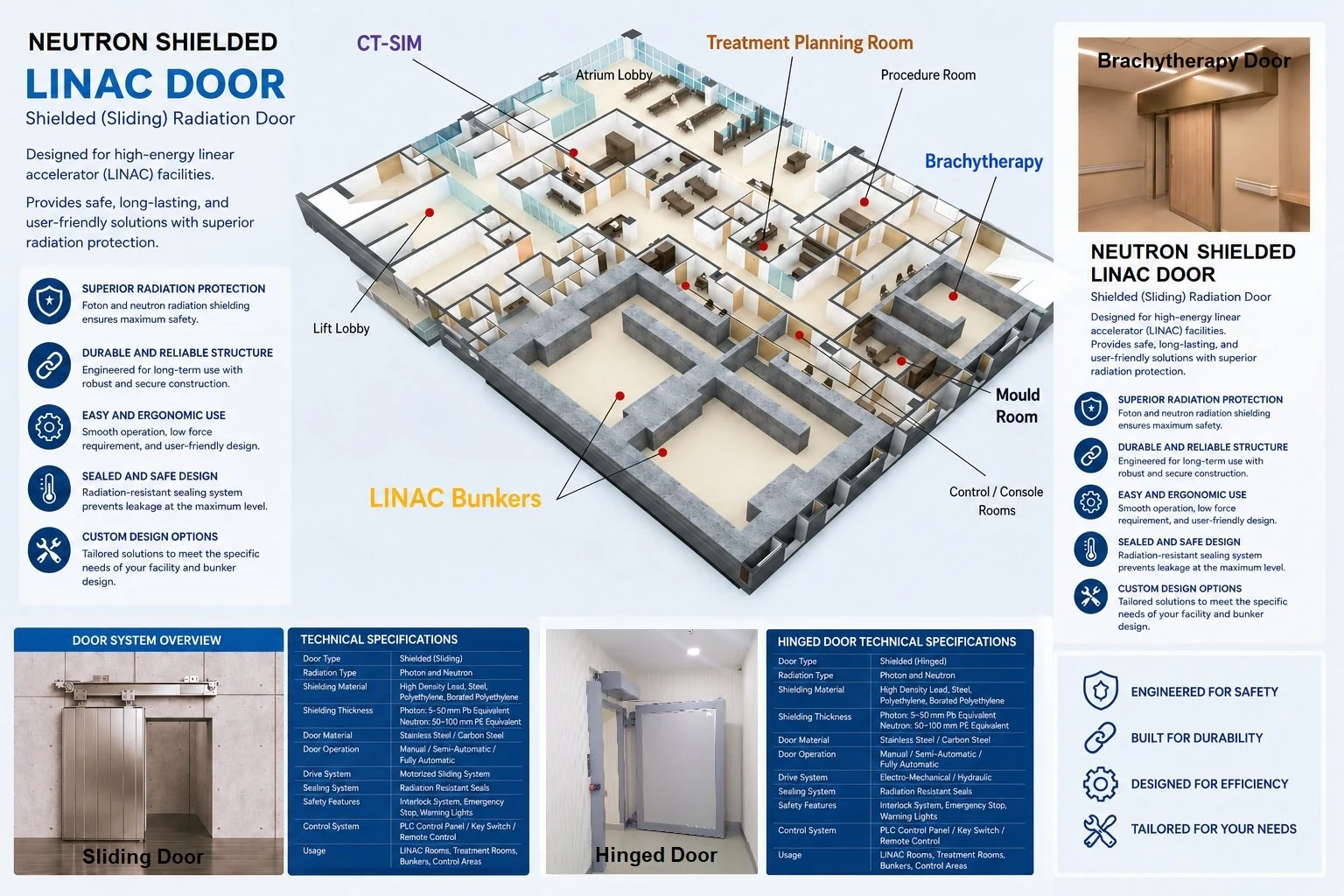
What Is a Neutron Shielded Door?
A Neutron Shielded Door is a specialized radiation protection door designed to attenuate neutron radiation generated by high-energy medical linear accelerators (LINACs), proton therapy systems, and other particle-producing radiation equipment.
Unlike conventional radiation shielding doors that primarily block photon radiation using lead, neutron shielded doors incorporate hydrogen-rich materials such as borated polyethylene or borated paraffin to effectively absorb and reduce neutron exposure.
These doors are critical components of modern radiotherapy facilities, ensuring the safety of healthcare professionals, patients, and the public while maintaining compliance with international radiation protection standards.
Why Is Neutron Shielding Necessary?
When a medical linear accelerator operates above 10 MV photon energy, interactions within the accelerator head can produce secondary neutrons. These photoneutrons possess unique physical properties and require specialized shielding approaches that differ significantly from conventional photon protection.
Without proper neutron shielding:
- Radiation levels may exceed regulatory limits.
- Staff exposure can increase.
- Public areas may be inadequately protected.
- Licensing and regulatory approval processes may be delayed.
- Long-term operational risks may increase.
Effective neutron shielding design helps maintain a safe and compliant treatment environment.
Where Are Neutron Shielded Doors Used?
Neutron shielded doors are commonly installed in:
- High-energy LINAC treatment rooms
- 15 MV and 18 MV radiotherapy bunkers
- Proton therapy centers
- Research radiation facilities
- Particle accelerator installations
- Specialized oncology treatment centers
As treatment technologies advance, the demand for high-performance neutron shielding solutions continues to grow worldwide.
Key Components of a Neutron Shielded Door
Neutron Attenuation Layer
The primary neutron shielding layer typically consists of:
- Borated polyethylene
- Borated paraffin
- Hydrogen-rich composite materials
These materials effectively slow down and absorb neutrons before they can reach occupied areas.
Photon Shielding Layer
Neutron interactions often generate secondary gamma radiation. Therefore, neutron shielding doors frequently incorporate:
- Lead shielding
- Steel shielding
- High-density radiation protection materials
This dual-layer approach provides comprehensive radiation protection.
Structural Reinforcement
Because neutron shielded doors can weigh several tons, robust structural engineering is essential.
Key elements include:
- Heavy-duty steel frames
- Reinforced support systems
- Precision-engineered hinges or sliding mechanisms
- Long-life operational components
Radiation-Tight Sealing
Even small gaps can become pathways for radiation leakage.
Advanced sealing systems help maintain:
- Radiation containment
- Door alignment accuracy
- Long-term shielding performance
- Regulatory compliance
Sliding vs Hinged Neutron Shielded Doors
Sliding Neutron Shielded Doors
Sliding doors are often selected for large treatment facilities because they provide:
- Reduced operational force
- Efficient space utilization
- Automation compatibility
- Superior handling of heavy shielding assemblies
Hinged Neutron Shielded Doors
Hinged doors remain a practical solution for many facilities due to:
- Simpler mechanical design
- Lower maintenance requirements
- Cost-effective installation
- Reliable long-term operation
The optimal choice depends on room layout, shielding requirements, workflow considerations, and project budget.
Design Factors Affecting Neutron Shielding Requirements
Every radiotherapy project is unique. Shielding door requirements depend on multiple factors including:
Beam Energy
Higher beam energies generate greater neutron production and often require increased shielding thicknesses.
Treatment Workload
Facilities treating large patient volumes may require enhanced shielding performance.
Maze Geometry
The design of the treatment room maze significantly influences neutron and photon levels at the door location.
Occupancy of Adjacent Areas
The intended use of nearby spaces determines allowable dose limits and shielding requirements.
Regulatory Standards
Shielding calculations are typically based on internationally recognized guidance documents such as NCRP recommendations, IAEA guidelines, and local radiation safety regulations.
Engineering Challenges in Neutron Shielded Door Design
Designing a neutron shielding door involves much more than selecting shielding materials.
Successful projects require expertise in:
- Radiation physics
- Neutron attenuation calculations
- Structural engineering
- Mechanical design
- Door automation systems
- Installation logistics
- Acceptance testing and commissioning
Each project must balance radiation safety, operational efficiency, and construction feasibility.
The Importance of Custom Shielding Solutions
There is no universal neutron shielding door suitable for every facility.
Factors such as:
- Accelerator model
- Maximum beam energy
- Bunker layout
- Regulatory requirements
- Future expansion plans
must all be evaluated before determining the optimal shielding configuration. Custom-engineered solutions provide the highest levels of safety, performance, and cost efficiency.
Why Professional Expertise Matters
The effectiveness of a neutron shielded door depends on accurate calculations, quality manufacturing, and proper installation.
Experienced engineering teams can support:
- Shielding design studies
- Radiation calculations
- Door engineering
- Manufacturing oversight
- Installation planning
- Commissioning support
This integrated approach minimizes project risks while ensuring regulatory compliance.
Conclusion
Neutron Shielded Door Design is a critical aspect of every high-energy radiotherapy facility. As treatment technologies continue to evolve, the need for advanced neutron protection solutions becomes increasingly important.
By combining accurate shielding calculations, proven engineering principles, and high-quality manufacturing, neutron shielded doors help create safe, compliant, and efficient treatment environments for modern cancer care facilities worldwide.
Whether planning a new LINAC bunker, upgrading an existing treatment room, or evaluating neutron shielding requirements, investing in a professionally engineered neutron shielded door solution is essential for long-term operational success.
Planning a radiotherapy shielding project?
Our engineers respond to technical inquiries within one business day — shielding calculations, door specifications and full project quotations.
Request a Technical Quote →