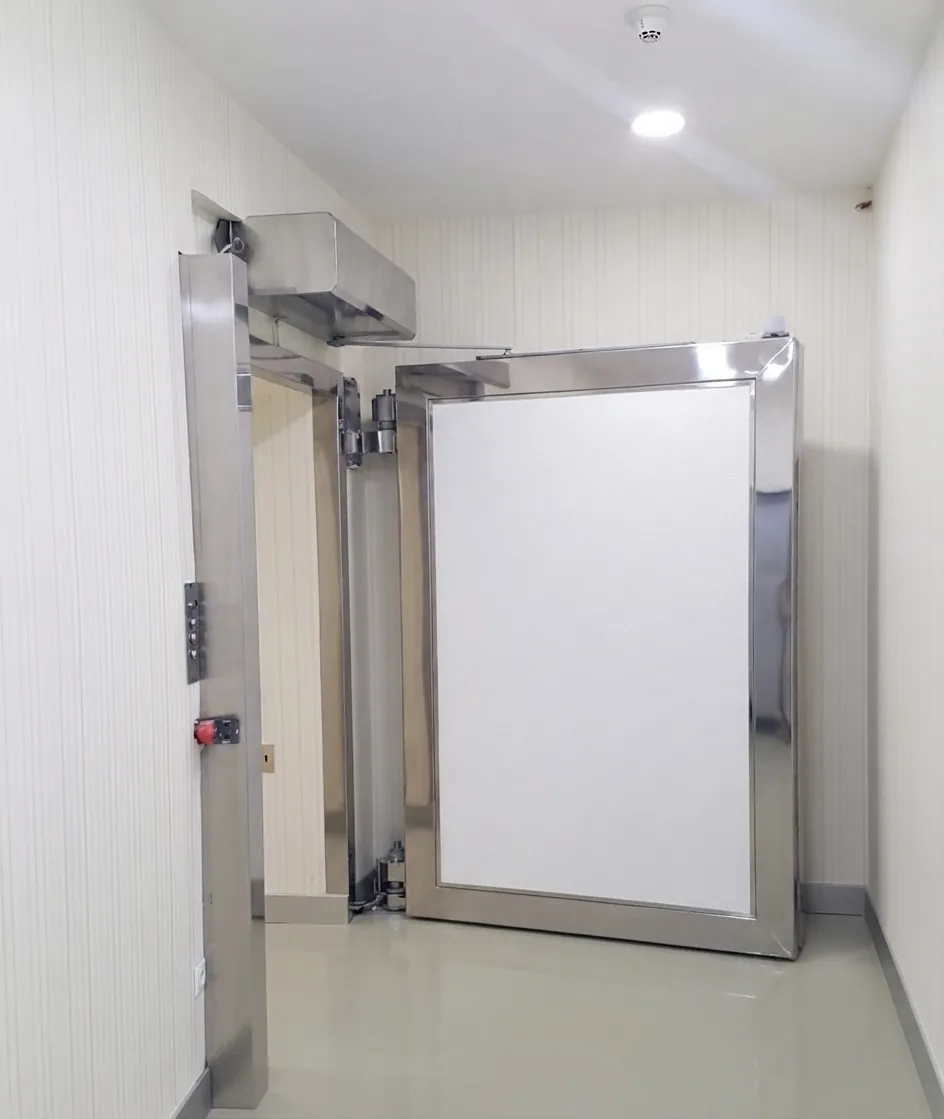
A swing LINAC door is not an ordinary industrial door that happens to be heavy. It is a moving radiation barrier: a multi-tonne shielded leaf whose mechanical behaviour forms part of the treatment vault's radiation protection system. And the component that decides whether that barrier keeps performing for fifteen years or becomes a clinical liability is almost never the shielding material itself — it is the hinge system.
This article explains, from an engineering standpoint, why the hinge of a hinged (swing) LINAC door deserves the same rigour as the shielding calculation — and what happens when it does not get it.
A Five-Tonne Door May Operate Hundreds of Times Every Day
Consider a busy radiotherapy centre where one linear accelerator treats approximately 50 patients per day. For each patient, radiotherapy technologists must enter and leave the treatment room repeatedly to:
- Assist the patient onto and off the treatment couch
- Complete initial positioning
- Align the patient with the room lasers
- Apply immobilisation equipment
- Verify and, when necessary, correct the patient's position
- Respond to movement or another clinical requirement
Depending on the treatment technique and workflow, this means 2–5 room entries per patient. The treatment-room door may therefore complete approximately 250–300 opening and closing cycles per day. If the centre operates around 250 clinical days per year, the numbers compound quickly:
| Operating period | Estimated door cycles |
|---|---|
| One day | 250–300 |
| One year | 62,500–75,000 |
| Ten years | 625,000–750,000 |
| Fifteen years | 937,500–1,125,000 |
These figures describe a design scenario for a high-workload centre rather than a universal value — the actual duty must be established from the centre's patient volume, treatment techniques and operating hours. But the engineering challenge they illustrate is real:
A swing LINAC door weighing several tonnes may be required to preserve its movement, alignment and radiation shielding integrity for close to — or more than — one million cycles.
This is why the hinge system cannot be treated as a standard door accessory. It is one of the principal structural and functional systems of a hinged LINAC door.
A Swing LINAC Door Is Part of the Radiation Shielding Barrier
A LINAC treatment vault is designed as a complete shielding envelope: concrete walls, primary and secondary barriers, maze configuration and the entrance door work together to keep radiation exposure outside the treatment room below the applicable design goals. NCRP Report No. 151 bases this design on parameters including workload, use factor and occupancy — and the treatment-room entrance must be evaluated as part of the complete vault design, not as an independent architectural opening.
Depending on accelerator energy and vault geometry, the door may need to attenuate leakage photons, patient- and maze-scattered radiation, photoneutrons and neutron-capture gamma radiation. High-energy LINAC doors therefore commonly use laminated shielding structures: high-atomic-number materials such as lead or steel for photon attenuation, and hydrogen-rich materials such as borated polyethylene (BPE) for neutron moderation and capture, with additional layers where capture-gamma attenuation is required.
The mass created by these shielding layers is ultimately transferred to the supporting structure. In a swing door, that load is carried primarily through the hinge system and its connection to the frame and reinforced building structure.
The Structural Load: A Multi-Tonne Eccentric Moment
The weight of a hinged door does not act through the hinge axis. The door's centre of gravity sits at a horizontal distance from the axis, so the hinge line must resist a substantial bending moment:
M = W × e
where M is the static moment at the hinge axis, W is the gravitational force generated by the door mass, and e is the horizontal distance from the hinge axis to the centre of gravity. A simplified example:
- Door mass: 5,000 kg → gravitational force ≈ 49.1 kN
- Centre-of-gravity distance from hinge axis: 0.75 m
- Static moment: M ≈ 49.1 kN × 0.75 m ≈ 36.8 kN·m — carried continuously, before any motion, wear or dynamic effect is considered
This simplified calculation illustrates the scale of the load, but it is not a hinge-selection calculation. Final engineering must also consider the actual centre-of-gravity location, door dimensions and thickness, the number and spacing of hinge points, load distribution between hinges, radial and axial bearing capacity, dynamic amplification, emergency stopping loads, operator acceleration and deceleration, frame stiffness, anchorage, welded and bolted connection strength, material fatigue, and bearing and pin wear.
The Hinge Must Preserve More Than Movement
The obvious function of a hinge is to let the door rotate. For a radiation shielding door, that is only part of its responsibility. The hinge system must also preserve the designed position of the shielding leaf relative to the frame and surrounding wall: when closed, the door must return consistently to the geometry established by the shielding design. This is particularly important at the hinge-side overlap, the leading edge, the top of the opening, the threshold, interfaces between shielding materials and frame-to-wall transitions.
Radiation travels through gaps and discontinuities far more easily than through the full designed shielding thickness. Effective door design therefore depends not only on the shielding material inside the leaf, but on controlling radiation streaming around the perimeter. The hinge must preserve the required overlap and closed position after repeated operation — if progressive wear or deformation changes this position, a mechanical problem becomes a radiation protection problem.
What Happens When a Heavy Swing Door Begins to Sag?
Even a small angular change at the hinge axis produces a noticeable vertical displacement at the unsupported edge of a wide door. The displacement at the leading edge can be approximated as δ ≈ L × θ. For a door leaf 1.5 m wide, an angular change of only 0.2° (≈ 0.00349 rad) gives:
δ ≈ 1.5 m × 0.00349 ≈ 5.2 mm at the leading edge
A change that appears negligible at the hinge becomes operationally significant at the opposite edge of the door. Four consequences follow:
1. Loss of radiation shielding integrity
Door sag alters the designed overlap between the shielding leaf, frame and wall, and may open a radiation streaming path around the perimeter. The lead, steel or BPE inside the leaf only provides its intended performance if the closed position — the geometry the shielding calculation assumed — is maintained. Shielding thickness and shielding geometry are two different requirements; sag attacks the second, and with it the door's radiation-tightness.
2. Contact with the floor
As the unsupported edge moves downward it may contact the finished floor, threshold or guide surface. The operator must then overcome additional friction, increasing loading on the motor and gearbox, drive arm, hinge bearings and pins, frame connections, structural anchors, and the door surface and flooring. Eventually the door may become difficult to move — or jam completely.
3. Increased downtime risk
A LINAC cannot normally operate unless its treatment-room access system closes correctly and the safety interlock confirms the protected condition. A failed hinge system is therefore not merely a maintenance inconvenience: it can interrupt patient treatments, disrupt clinical schedules and require specialist intervention on a multi-tonne shielding assembly.
4. Accelerated mechanical deterioration
Misalignment increases resistance during movement; increased resistance creates additional loading, which accelerates wear and worsens the original misalignment. The failure sequence is progressive: wear or structural movement → door sag → increased friction → higher operating load → further wear → loss of movement or alignment. Early identification and correction are far preferable to waiting for the door to become immovable.
Static Capacity Alone Is Not Enough
A hinge assembly may be capable of supporting the door's static mass while still being unsuitable for the application, because the duty is defined by two requirements together: load capacity and repeated-cycle performance. Repeated opening and closing creates fluctuating stresses in pins, bearings, welds, plates, fasteners and structural connections; starting and stopping produce dynamic loads beyond the static gravitational load.
The hinge design should therefore address static strength, fatigue resistance, bearing life, wear allowance, stiffness under load, replaceability of wearing components, lubrication and maintenance access, resistance to unintended movement and long-term alignment stability — and, where appropriate, allow controlled adjustment during installation and maintenance.
The Door Operator Must Not Be Used to Correct Poor Hinge Geometry
The automatic operator moves the door; it should not be expected to carry the door or compensate continuously for a misaligned hinge system. If the leaf has sagged, increasing motor torque may temporarily force the door to move — but it does not correct the underlying problem. It transfers excessive load to the gearbox, drive mechanism, frame and anchors.
The hinge and supporting structure must carry and guide the shielding leaf correctly; the operator should only provide the controlled force required for movement.
Force limits, obstacle detection, safety edges, presence sensors, emergency operation and interlocks remain essential — but they cannot compensate for inadequate mechanical support.
Project-Specific Hinge Engineering
There is no universal hinge arrangement suitable for every swing LINAC door. A low-energy maze door and a direct-shielded high-energy door may differ dramatically in thickness, mass, radiation composition and operating duty. A professional engineering assessment proceeds through defined stages:
- Determine the radiation shielding composition — the materials and thicknesses required for photons, neutrons and neutron-capture gamma radiation define most of the door's final mass and thickness.
- Calculate the complete door mass — including structural steelwork, internal support members, surface finishes, frames and overlap sections, safety equipment, drive components mounted on the leaf, cabling and accessories.
- Establish the centre of gravity — a laminated door rarely has a symmetrical mass distribution; the centre of gravity must be calculated from the actual location and density of each component.
- Define the operating duty — expected daily cycles, treatment days per year, intended service life and unusual workflows, agreed with the facility. A department treating 20 patients per day does not impose the same operating duty as a centre treating 50 or more patients across extended working hours.
- Analyse the hinge and structural connections — capacity and stiffness of hinge pins and shafts, bearings or bushings, hinge plates, welded and bolted joints, the door frame, structural anchors and reinforced wall interfaces.
- Control acceleration and deceleration — drive profiles that limit dynamic loads on the hinge line and anchorage.
- Verify the installed geometry — factory quality alone cannot guarantee site performance; final alignment depends on the opening dimensions, wall verticality, floor level and flatness, frame position, hinge-axis verticality, anchor and embedment locations, clearance through the entire swing path and the final overlap in the closed position. For very heavy assemblies, survey instruments may be required to establish and document the geometry accurately.
- Commission the completed assembly — confirming smooth and controlled motion, correct closed position, consistent perimeter overlap, safety-system operation, emergency operation, interlock functionality, and radiation survey results under the conditions defined by the medical physicist.
Ongoing monitoring should then watch for changes in leading-edge height, top and bottom clearances, closed-position repeatability, perimeter overlap, unusual sound or vibration, increased opening or closing force, bearing and pin condition, lubrication condition, loose fasteners, weld cracking, frame or anchor movement, floor contact or surface damage, and operator current or torque trends. Any significant change in closed geometry should be evaluated mechanically — and where the shielding overlap may have changed, the facility's medical physicist or radiation protection expert should decide whether a new radiation survey is required.
Why Direct-Shielded Doors Require Particular Attention
Published AAPM material on direct-shielded doors shows that a door without the protection of a conventional maze can require substantial photon and neutron shielding — in one referenced 18 MV example, a thick polyethylene assembly for neutron attenuation alongside shielding for capture-gamma radiation and head leakage. The purpose of the example is not to establish a universal door specification; it illustrates how vault geometry and accelerator energy can produce an extremely thick and heavy entrance barrier.
As shielding mass increases, the static hinge reaction increases, the bending moment increases, structural-frame demands increase, dynamic control becomes more difficult, and the consequences of misalignment become more severe. For this reason, the hinge concept should be developed together with the shielding composition and structural door design — not selected after the leaf has already been manufactured.
The Hinge Is a System, Not a Catalogue Component
MSA Projecta does not approach a swing LINAC door hinge as a standalone commercial accessory. The hinge is engineered as part of the complete radiation shielding door system, integrating radiation shielding calculations, door-leaf construction, structural load transfer, frame and anchorage engineering, required operating-cycle life, automatic movement, functional safety, installation tolerances, commissioning requirements and long-term maintainability.
This integrated approach is essential because the objectives are interconnected: a door can only preserve radiation shielding integrity if it maintains its designed geometry — and it can only maintain that geometry if its hinges, frame and supporting structure remain stable throughout its service life.
Conclusion
A five-tonne swing LINAC door operating up to 300 times per day presents a very different engineering problem from a conventional heavy industrial door. Its hinge system must support a large eccentric load, resist repeated dynamic stresses, preserve the hinge axis, maintain the designed closed position, prevent progressive sag, protect the automatic drive from unnecessary loading, preserve perimeter shielding geometry and remain inspectable and maintainable over its service life.
The most serious hinge failure is not always a broken component. Progressive movement of only a few millimetres may be enough to affect floor clearance, increase drive resistance or alter the radiation shielding geometry around the entrance. Treating the hinge as a core engineered system — from shielding calculation through commissioning — protects the door's structural reliability, clinical availability and radiation protection performance.
Planning a hinged LINAC door or a complete radiotherapy shielding project?
Our engineers design swing LINAC doors as complete systems — shielding composition, door mass, hinge and structural engineering, automation and commissioning. Technical inquiries are answered within one business day.
Request a Technical Quote →Frequently Asked Questions
How many times does a swing LINAC door operate per day?
In a busy centre treating around 50 patients per day, technologists may enter the room 2–5 times per patient, so the door may complete roughly 250–300 cycles per day. The actual design duty should always be established from project-specific clinical data.
Can a standard heavy industrial hinge be used for a LINAC door?
A hinge should not be selected on nominal door mass alone. The design must also account for the eccentric moment, centre of gravity, cycle life, dynamic loads, bearing life, frame stiffness, anchorage and long-term alignment stability.
Why can hinge sag affect radiation-tightness?
Entrance shielding depends on the door returning to its designed closed position and maintaining the required overlap with the frame and wall. Sag or angular movement changes this geometry and can open a radiation streaming path around the perimeter.
Does the hinge determine the shielding thickness?
No. Shielding requirements are determined from accelerator energy, workload, vault geometry, maze configuration, occupancy and radiation protection design goals. The shielding composition then determines door mass and influences the required hinge system.
Are high-energy LINAC doors always heavier?
Not always — maze geometry can substantially reduce the shielding required at the entrance. However, accelerators above about 10 MV produce photoneutrons, requiring evaluation of neutron and capture-gamma shielding; direct-shielded or short-maze doors can consequently become extremely heavy.
What should be checked during maintenance?
Door level, edge clearances, closed-position repeatability, overlap geometry, hinge and bearing wear, fasteners, welds, anchors, frame movement, operator loads, safety devices and interlock operation. If the closed geometry has changed, the medical physicist should evaluate whether a new radiation survey is required.
Does MSA Projecta sell standalone LINAC door hinges?
No. MSA Projecta engineers complete swing LINAC door systems — the heavy-duty hinge assembly forms part of the complete project-specific design, including shielding, structural support, automation, safety and installation requirements.
References
- National Council on Radiation Protection and Measurements. NCRP Report No. 151: Structural Shielding Design and Evaluation for Megavoltage X- and Gamma-Ray Radiotherapy Facilities.
- NCRP-151: LINAC Vault Shielding — Oncology Medical Physics
- McGinley, P. H. Direct Shielded Doors: Sliders and Swingers — 2007 AAPM Summer School
- Tanny, S. M., Sperling, N. N., and Parsai, E. I. Investigation of Scattered Radiation Dose at the Door of a Radiotherapy Vault When the Maze Intersects the Primary Beam